

[ad_1]
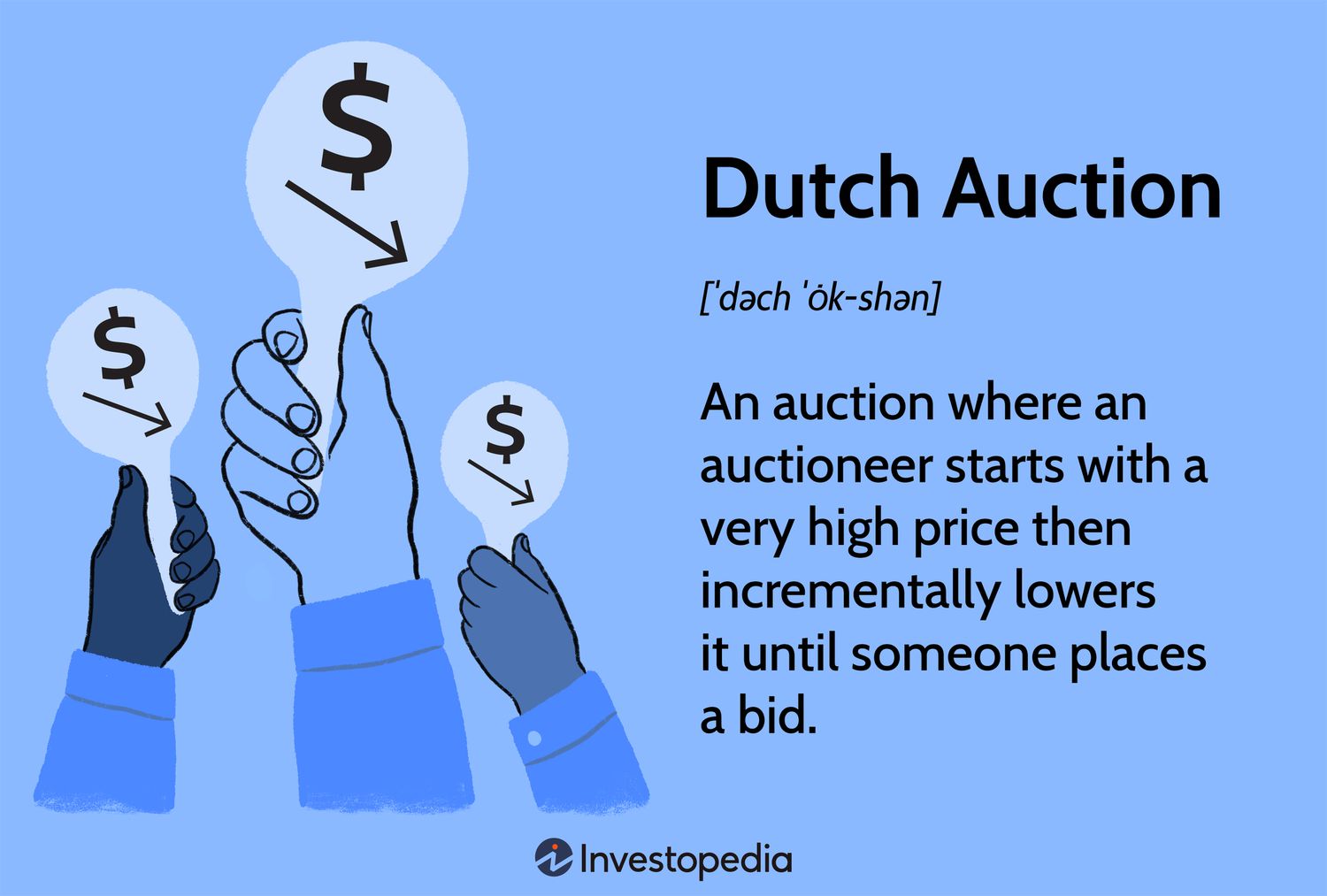
In a Dutch auction, an auctioneer starts with a high price and lowers it until someone bids. This differs from traditional auctions, in which the price starts low and rises as bidders compete.
The first bid in a Dutch auction wins the auction (assuming the price is above the reserve price), avoiding any bidding wars.
Dutch auctions are used to sell initial public offerings (IPOs), U.S. Treasury securities, floating-rate debt, and other securities.
Benefits of Dutch auctions include the democratization of public offerings and transparency in pricing. Potential drawbacks and risks include less price control and possible price volatility.
Key Takeaways
- In a Dutch auction, securities are sold at the lowest price necessary to sell the entire offering, benefiting broad investor participation.
- Dutch auctions help democratize IPOs by allowing individuals, not just favored clients of underwriting banks, to bid on shares.
- The U.S. Treasury uses Dutch auctions to sell Treasury securities efficiently, prioritizing bids with the lowest yields.
- Dutch auctions can increase transparency in pricing but may lead to volatility if investors overbid.
- Google’s IPO in 2004 utilized a Dutch auction to avoid a drastic price surge on its first trading day.
Daniel Fishel / Investopedia
How Dutch Auctions Work in IPOs
Financial markets use a slightly different version of a Dutch auction. There, a Dutch auction happens when investors place bids for a security offering, specifying what they are willing to buy in terms of quantity and price. The offering price is set at the highest price that sells the entire offering.
If a company is using a Dutch auction for an initial public offering (IPO), potential investors enter their bids for the number of shares they want to purchase as well as the price they are willing to pay. For example, an investor may place a bid for 100 stock shares at $100 while another investor offers $95 for 500 shares.
Once all the bids are submitted, the allotted placement is assigned to the bidders from the highest bids down, until all the allotted shares are assigned. Each bidder pays the lowest successful bid price, essentially the last successful bid. Therefore, even if you bid $100 for your 1,000 shares, if the last successful bid is $80, then you will only have to pay $80 for your 1,000 shares.
Tip
IPOs are typically open to favored investors of the underwriting banks. In a Dutch auction, individual investors can join, making the IPO process more democratic.
U.S. Treasury’s Use of Dutch Auctions Explained
The U.S. Treasury uses a Dutch auction to sell its securities. The U.S. Treasury holds regular auctions for Treasury bills, notes, and bonds to finance the country’s debt.
Prospective investors submit bids electronically through TreasuryDirect or the Treasury Automated Auction Processing System (TAAPS), which accepts bids up to 30 days in advance of an auction. Suppose the Treasury seeks to raise $9 million in two-year notes with a 5% coupon. Let’s assume the submitted bids are as follows:
- $1 million at 4.79%
- $2.5 million at 4.85%
- $2 million at 4.96%
- $1.5 million at 5%
- $3 million at 5.07%
- $1 million at 5.1%
- $5 million at 5.5%
The lowest-yield bids are accepted first, as the issuer prefers to pay less to bond investors. In this case, since the Treasury is looking to raise $9 million, it will accept the bids with the lowest yield up to 5.07%. At this mark, only $2 million of the $3 million bid will be approved. All bids above the 5.07% yield will be rejected, and bids below will be accepted. In effect, this auction is cleared at 5.07%, and all successful bidders receive the 5.07% yield.
Did You Know?
The term “Dutch auction” originated in 17th-century Holland to make the Dutch tulip market more efficient.
Insights into Lowest-Bidding Dutch Auctions
At a lowest-bidding Dutch auction, prices start high and are dropped successively until a bidder accepts the going price. Once a bid is accepted, the auction ends.
For example, say an auctioneer starts at $2,000 for an item. The bidders watch the price decline until it reaches a price that one of the bidders accepts. No bidder sees the others’ bids until after their own bid is formulated, and the winning bidder is the one with the highest bid. So, if there are no bidders at $2,000, the price is lowered by $100 to $1,900, and the bidding moves lower from there if no one bids at $1,900. If a bidder accepts the item of interest at, say, the $1,500 mark, the auction ends.
Advantages of Dutch Auctions in Public Offerings
The use of Dutch auctions for initial public offerings offers benefits that include:
- Democratization of public offerings. The process for conducting a typical IPO is mostly controlled by investment banks. They act as underwriters to the offering and shepherd it through road shows, enabling institutional investors to purchase securities of the issuing company at a discount. They are also responsible for setting the IPO’s price. A Dutch auction allows small investors to take part in the offering.
- Increased transparency. Institutional investors take advantage of this difference to rake in profits by purchasing shares at a discount and selling them immediately after the stock is listed. Dutch auction prices are set by a fairer and more transparent method in which an array of bids from multiple types of customers are invited. This practice is meant to ensure that the market arrives at a reasonable estimate of the firm’s value and that the initial “pop” that accompanies the listing of a hot company is muted.
Challenges of Dutch Auctions: A Closer Look
But there are also some drawbacks, including:
- Less price control. Because the auction is open to investors of all stripes, there is a danger that they may perform less rigorous analysis compared to investment bankers, and they could come up with a price estimate that may not accurately reflect the company’s prospects.
- Potential price volatility. Another drawback of Dutch auctions is known as the winner’s curse. In this, a stock’s price may crash immediately after listing when investors, who had bid a higher price earlier, realize that they may have miscalculated or overbid. Such investors may try to sell the stock to get out of their holding, leading to a crash in the share’s price.
Notable Example: Google’s Dutch Auction IPO
One of the most prominent examples of a Dutch auction was Google’s IPO in August 2004. The company opted for this type of offering to prevent a “pop” in its prices on the first day of trading.
While the increase in share prices is a standard phenomenon in stock markets, it had escalated to bubble territory for tech stocks during the internet bubble of 2000. From 1980 to 2001, the pop in first-day trading was 18.8%. That figure jumped to 77% in 1999 and in the first half of 2000.
Google’s initial estimate for its offering was 25.9 million shares in the range of $108 to $135. But the company revised its expectations about a week before the actual offering after analysts questioned the reasoning behind those figures and suggested that Google was overpricing its shares. In the revised estimate, Google offered to sell 19.6 million shares to the public at a price range of $85 to $95.
The response to the offering was considered a disappointment. Although Google was considered a hot company and offering, investors priced its shares at $85, the lower range of its estimates. By the end of the day, the shares were exchanging hands at $100.34, a pop of 17.6% during the first day of trading.
Observers blamed the poor performance on negative press reports about the company ahead of its IPO. A U.S. Securities and Exchange Commission (SEC) inquiry into its executive share allocation further dampened enthusiasm for Google’s offering. The company was also said to be secretive about its use of raised funds, making it difficult to evaluate its offering, especially for small investors not aware of the emerging market for search engines and organizing information on the web.
What Is an Initial Public Offering (IPO)?
An IPO is a company’s first sale of stock available to the public. Often, securities offered in IPOs are from newer, smaller companies seeking outside equity capital and a public market for its stock.
Why Is It Called a Dutch Auction?
The term “Dutch auction” stems from the auction style used in 17th-century Holland’s tulip markets. The bulbs were wildly popular, and the marketplace for them had been chaotic. The exchange decided that the best way to sell the tulip bulbs was to do it quickly in as few bids as possible—while still getting the best possible price.
How Do You Win a Dutch Auction?
In a Dutch auction, an item is offered at a set maximum price, which is incrementally lowered until a bid is made. Whoever places the first bid wins the auction, provided the bid is above the auction’s reserve price.
The Bottom Line
Dutch auctions are democratic, allowing broader participation beyond institutional investors, and offer increased transparency in the pricing process that potentially leads to fairer outcomes.
Google’s 2004 IPO is a notable example of how Dutch auctions are applied in real-world scenarios.
Advantages of Dutch auctions include providing all participants with the same pricing, reducing the potential conflicts that arise in traditional IPOs. Potential drawbacks include the winner’s curse, where miscalculated bids can lead to post-IPO price volatility.
Inform yourself about the target company and the specifics of the Dutch auction process, and assess your financial situation and risk tolerance, before you commit to a Dutch auction bid.
[ad_2]


