

[ad_1]
What Is the Coase Theorem?
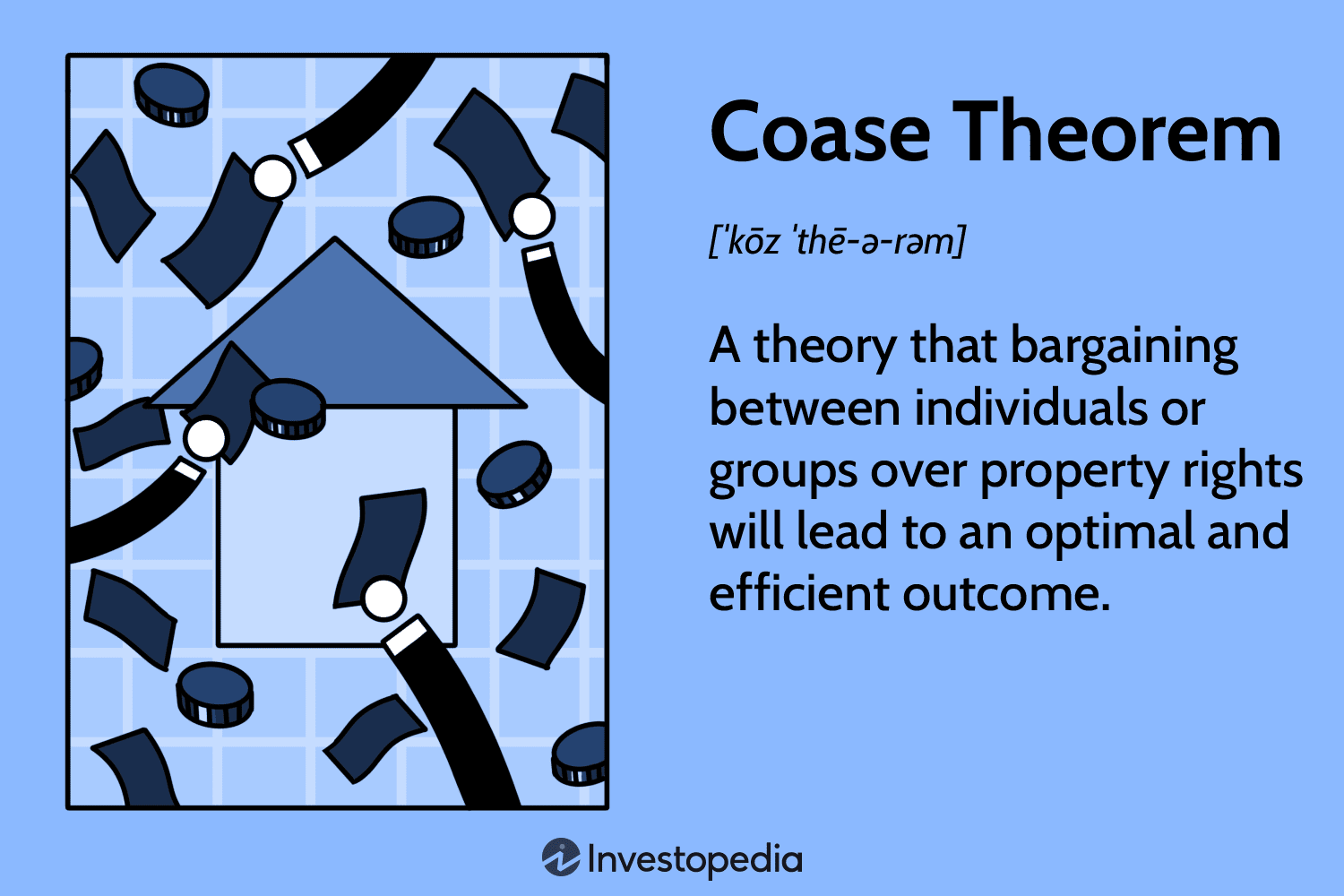
The Coase Theorem, formulated by economist Ronald Coase, articulates a key principle in economics and law concerning property rights. It posits that in perfect market conditions without transaction costs, parties disputing property rights can efficiently resolve issues through bargaining.
This theorem underscores the potential for optimal allocation of resources when market conditions are perfect, encouraging solutions driven by negotiation rather than regulation.
Key Takeaways
- The Coase Theorem posits that under zero transaction costs and perfect market conditions, property rights conflicts can be resolved efficiently through private negotiation.
- For the theorem to hold true, ideal conditions such as perfect information and equal bargaining power must exist, which are rarely found in real-world scenarios.
- The Coase Theorem is often used to understand why ideal economic outcomes are not achieved in practice due to the presence of transaction costs and market imperfections.
- Ronald Coase developed the theorem to critique government intervention, suggesting that private settlements can be more effective in resolving property rights disputes.
- While the Coase Theorem offers valuable insights in economics and law, its practical application is limited by the complexities and imperfections of real-world markets.
Applying the Coase Theorem to Resolve Property Rights Conflicts
The Coase Theorem applies to conflicts over property rights. The Coase Theorem states that under ideal economic conditions, where there is a conflict of property rights, the involved parties can bargain or negotiate terms that will accurately reflect the full costs and underlying values of the property rights at issue, resulting in the most efficient outcome.
For this to occur, the conditions conventionally assumed in the analysis of efficient, competitive markets must be in place, particularly the absence of transaction costs. The information must be free, perfect, and symmetrical.
A key point of the Coase Theorem is that bargaining should be free; costs like meetings or enforcement can affect results. Neither party can possess market power relative to the other so that bargaining power between the parties can be equal enough that it does not influence the outcome of the settlement.
The Coase Theorem shows that where property rights are concerned, involved parties do not necessarily consider how the property rights are divided up if these conditions apply and that they care only about current and future income and rent without regard to issues such as personal sentiment, social equity, or other noneconomic factors.
The Coase Theorem has been widely viewed as an argument against the legislative or regulatory intervention of conflicts over property rights and privately negotiated settlements thereof. Ronald Coase developed it while examining radio frequency regulation. He posited that regulating frequencies was not required because stations with the most to gain by broadcasting on a particular frequency had an incentive to pay other broadcasters not to interfere.
Exploring Real-Life Applications of the Coase Theorem
The Coase Theorem applies when one party’s economic activities impose costs or damage on another’s property. Based on the bargaining that occurs during the process, funds may either be offered to compensate one party for the other’s activities or to pay the party whose activity inflicts the damages in order to stop that activity.
For instance, if a factory’s machine noise leads to neighbor complaints, the Coase Theorem suggests two possible solutions.
The business may choose to offer financial compensation to the affected parties in order to be allowed to continue producing the noise, or the business might refrain from producing the noise if the neighbors can be induced to pay the business to do so, in order to compensate the business for additional costs or lost revenue associated with stopping the noise. The latter would not actually occur, so the result would be the business continuing operations with no exchange of money.
If the market value produced by the activity that is making the noise exceeds the market value of the damage that the noise causes to the neighbors, then the efficient market outcome to the dispute is that the business will continue making machines. The business can keep producing noise and pay neighbors from the revenue it earns.
If the machine-making value is less than the noise cost to neighbors, the business should stop, with neighbors compensating them. In the real world, however, neighbors would not pay a business to stop making machines because the cost of doing so is higher than the value they place on the absence of the noise.
Overcoming Challenges in Real-World Applications of the Coase Theorem
For the Coase Theorem to apply, efficient competitive market conditions around the dispute must exist. Otherwise, finding an efficient solution is unlikely.
These assumptions—zero transaction (bargaining) costs, perfect information, no market power differences, and efficient markets for all related goods and production factors—are obviously a high hurdle to pass in the real world where transaction costs are ubiquitous, information is never perfect, market power is the norm, and most markets for final goods and production factors do not meet the requirements for perfect competitive efficiency.
Because the conditions necessary for the Coase Theorem to apply in real-world disputes over the distribution of property rights virtually never occur outside of idealized economic models, some question its relevance to applied questions of law and economics.
Recognizing these real-world difficulties with applying the Coase Theorem, some economists view the theorem not as a prescription for how disputes ought to be resolved, but as an explanation for why so many apparently inefficient outcomes to economic disputes can be found in the real world.
Who Was Ronald Coase?
Ronald H. Coase was a British economist who made pathbreaking contributions to the fields of transaction cost economics, law and economics, and New Institutional economics. He was awarded the Nobel Memorial Prize in Economic Sciences in 1991 for his elucidation of the role of transaction costs, property rights, and economic institutions in the structure and functioning of the economy. He died in 2013 at age 102 in Chicago, Illinois, where he taught economics at the University of Chicago Law School.
What Are Other Contributions by Ronald Coase?
Ronald Coase is also known for the Coase Conjecture. It states that if a durable-goods monopolist can make offers to sell arbitrarily frequently, then in equilibrium, that monopolist will charge the competitive price, and the market will be saturated quickly.
What Are the Legal Implications of the Coase Theorem?
The Coase Theorem has been to analyze and resolve disputes involving contract law and tort law. In contract law, it is used as a method to evaluate parties’ power during the negotiation and acceptance of a contract. In tort law, it is used in application of economic analysis to assign liability.
The Bottom Line
The Coase Theorem, developed by economist Ronald Coase, explores how property rights disputes can be efficiently resolved through negotiation if there are no transaction costs, perfect information, and equal bargaining power.
Although these ideal conditions rarely exist in real-world markets, the theorem highlights the importance of property rights and negotiation in achieving efficient economic outcomes. Its application showcases the complexities of real-world economic and legal interactions and underscores the challenges of relying solely on market-based solutions without accounting for transaction costs and imperfect information.
[ad_2]


