[ad_1]
What Is the Cost of Living?
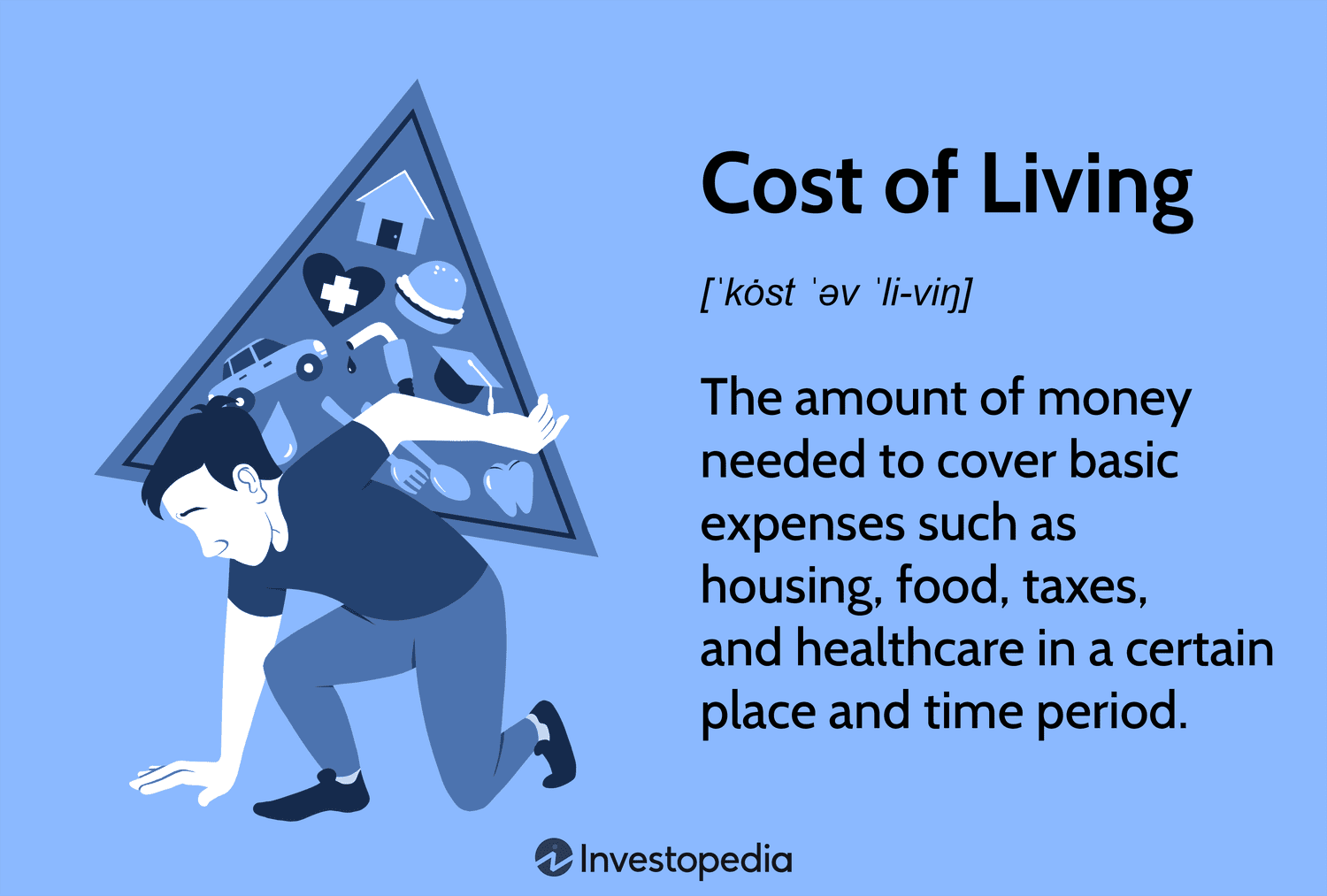
The cost of living refers to the money needed for essentials like housing, food, taxes, and healthcare in a specific location and time. It is often used to compare the expenses of living in different cities. Higher living costs, like in New York, require higher salaries to afford living in the area.
Key Takeaways
- Cost of living is the amount of money needed to sustain a certain standard of living by affording expenses such as housing, food, taxes, and healthcare.
- Salaries should reflect the higher cost of living in more expensive cities like New York City.
- The cost of living index enables comparison of the cost of living in one area to another.
How the Cost of Living Is Used
The cost of living can be a significant factor in personal wealth accumulation because a salary can provide a higher standard of living in a city where daily expenses such as rent, food, and entertainment are less.
In contrast, a high salary can seem insufficient in an expensive city such as New York. Changes in the Consumer Price Index (CPI) are often a triggering event in labor and other contracts with escalation clauses. The contract will detail exactly how any periodic adjustments happen and what parts of the contract will change.
In a 2024 survey, Mercer, a global human resources firm, finds the cities with the highest cost of living in order are Hong Kong, Singapore, Zurich, Geneva, and Basel. New York City ranked as the costliest city in the United States, followed by Los Angeles, Honolulu, and San Francisco.
The Cost of Living Index
The cost of living index compares the cost of living in one area to another. The index incorporates various living expenses creating an aggregate measure that workforce entrants can use as a benchmark.
As college graduates weigh employment alternatives and currently employed job seekers consider relocation, the index provides an informative snapshot of rental, transportation, and grocery costs.
Mercer’s cost of living index measures prices in 226 urban areas for a basket of goods, which includes 12 large eggs, one liter of olive oil, espresso coffee at a popular cafe, one liter of gasoline (unleaded 95), men’s blue jeans, and women’s shampoo, haircut, and styling.
The Economic Policy Institute updated its Family Budget Calculator in January 2025 with data from 2024. The calculator helps families determine how much salary they will need to cover the cost of living in 3,143 counties in all 613 metro areas.
Fast Fact
Four out of six of the world’s most expensive cities are in Switzerland: Zurich (third), Geneva (fourth), Basel (fifth), and Bern (sixth).
Most Expensive Urban Areas in the U.S.
According to The Council for Community and Economic Research, the 10 most expensive urban areas in the U.S. in 2023 (the most recent annual listing available from the council) were:
- New York (Manhattan)
- Honolulu
- San Jose, California
- San Francisco
- New York (Brooklyn)
- Orange County, California
- Los Angeles and Long Beach, California
- Washington, D.C.
- Boston
- Seattle
Least Expensive Urban Areas in the U.S.
According to The Council for Community and Economic Research, the 10 least expensive urban areas in the U.S. in 2023 (the most recent annual listing available from the council) were:
- Decatur, Illinois
- Harlingen, Texas
- McAllen, Texas
- Tupelo, Mississippi
- Ponca City, Oklahoma
- Muskogee, Oklahoma
- Conway, Arkansas
- Florence, Alabama
- Kalamazoo, Michigan
- Lawton, Oklahoma
U.S. States Ranked by Cost of Living
The following is a list of U.S. states, districts, and territories ranked by cost of living from lowest to highest during 2024:
- West Virginia
- Oklahoma
- Kansas
- Mississippi
- Alabama
- Arkansas
- Missouri (tied for 6th)
- Iowa
- Michigan
- Tennessee
- Indiana
- Georgia
- North Dakota
- South Dakota
- Louisiana (tied for 14th)
- Texas
- Kentucky
- Nebraska
- New Mexico
- Ohio
- Illinois
- Montana
- Minnesota
- Pennsylvania
- Wyoming
- South Carolina
- Wisconsin
- North Carolina
- Virginia
- Delaware
- Nevada
- Idaho
- Puerto Rico (tied for 32nd)
- Colorado (tied for 32nd
- Florida
- Utah
- Arizona
- Oregon
- Maine
- Rhode Island
- Connecticut
- New Hampshire
- Washington
- Vermont
- New Jersey
- Maryland
- New York
- Alaska
- District of Columbia
- California
- Massachusetts
- Hawaii
Cost of Living and Wages
The rising cost of living has spurred debate over the U.S. federal minimum wage and the disparity between the lowest salary allowed by law and the earnings needed to maintain an adequate cost of living.
Proponents of a hike in wages cite increased worker productivity levels since 1968 as inequitably correlated to the minimum hourly rate of pay. As pay levels once tracked the increase in productivity, the divergence between earnings and worker efficiency has reached historically disproportionate levels.
By contrast, opponents of a minimum wage contend that a raise could spur higher consumer prices as employers offset rising labor costs.
Minimum Wage
Twenty-one U.S. states raised their minimum wage on January 1, 2025. They are:
- Alaska
- Arizona
- California
- Colorado
- Connecticut
- Delaware
- Illinois
- Maine
- Michigan
- Minnesota
- Missouri
- Montana
- Nebraska
- New Jersey
- New York
- Ohio
- Rhode Island
- South Dakota
- Vermont
- Virginia
- Washington
Wage Increases and Cost-of-Living Adjustments (COLAs)
In 1973, Congress enacted legislation to address cost-of-living adjustments (COLAs). COLA adjustments for Social Security and Supplemental Security Income (SSI) benefits were instituted so that the payments keep pace with inflation.
For example, in December 2022, the COLA was 8.7% due to the high levels of inflation as a result of the COVID-19 pandemic, and the increased amounts were paid starting in January 2023. Federal SSI payment levels increased by the same percentage.
TheSocial Security Act requires COLAs to be based on increases in the Consumer Price Index for Urban Wage Earners and Clerical Workers (CPI-W).
The Social Security Administration (SSA) announced a COLA increase of 2.5% for 2025. That’s lower than what was announced for 2024, which was 3.2%. The agency noted that the average increase over the last 10-year period was 2.6%.
Which U.S. State Has the Highest Cost of Living?
According to the Missouri Economic Research and Information Center, Hawaii has the highest cost of living as of the end of 2024. It has a cost of living index of 186.9. That can be compared to the state with the lowest cost of living, which is West Virginia, with a cost of living index of 84.1.
What Is the Most Expensive City in the U.S.?
The most expensive city in the U.S. is New York City, as determined by various cost of living indexes.
Is Living in the U.S. Expensive?
The U.S. is one of the most expensive countries in the world to live in. Additionally, expenses for healthcare and college are extraordinarily high when compared to other countries. Many cities in the U.S. rank high in cost of living indexes. However, as the U.S. is a large country, living costs vary depending on location.
The Bottom Line
The cost of living refers to the expenses required to sustain a particular standard of living, including housing, food, taxes, and healthcare. It serves as a benchmark for comparing expenses across different areas and informs decisions about salaries and relocations.
A cost of living index aggregates these expenses, offering a detailed measure that helps individuals understand the financial requirements of different locations.
Rising living costs have ignited debates about wage increases and the need for cost-of-living adjustments. These measures seek to ensure that earnings are in step with inflation so that purchasing power is not reduced and economic stability is maintained.
[ad_2]