[ad_1]
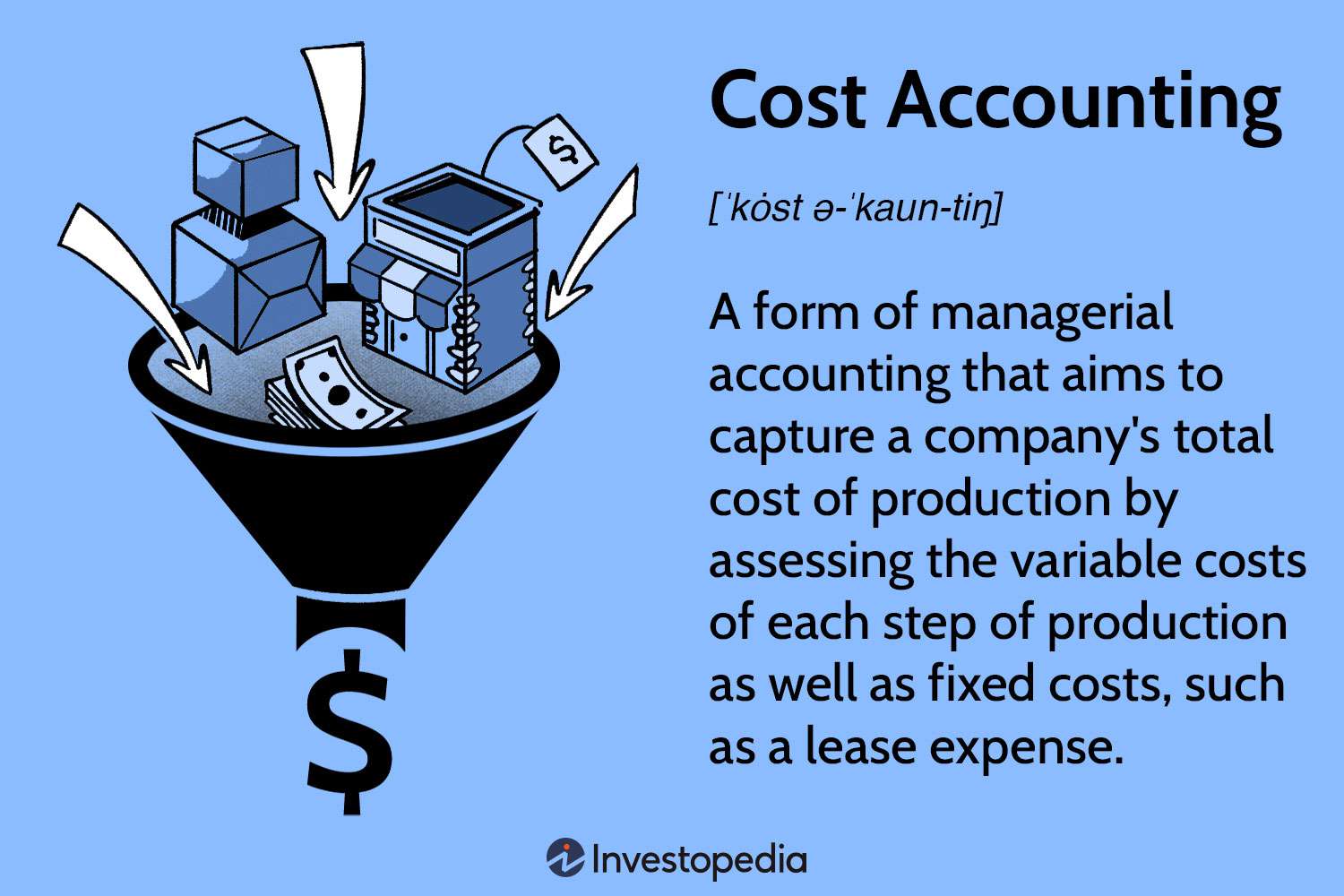
Cost accounting is a type of managerial accounting that businesses use to capture and analyze the total costs associated with producing goods or providing services.
It tracks both the fixed and variable costs within business operations. However, it’s not part of the generally accepted accounting principles (GAAP) and can only be used for internal management decisions.
Key Takeaways
- Cost accounting captures a company’s total production costs and helps in managerial decision-making.
- It involves analyzing fixed, variable, operating, direct, and indirect costs.
- Methods include standard costing, activity-based costing, lean accounting, and marginal costing.
- Unlike financial accounting, which produces financial statements for external evaluation, cost accounting is used only for internal purposes.
What Is Cost Accounting?
Cost accounting is a branch of financial management that helps organizations track and assess expenses incurred to create products or deliver services. After measuring and recording all input costs individually, companies can compare these figures against actual operational results.
Unlike financial accounting, which follows strict regulations, cost accounting is only used for internal decisions and is not bound by external reporting standards or regulations. This flexibility allows companies to tailor their cost accounting systems to their needs and operational requirements.
The primary objectives and benefits of cost accounting include the following:
- Determine the actual costs of products or services
- Provide data for budgeting and planning
- Support pricing decisions
- Identify areas for cost cuts
- Measure operational efficiency
- Inform strategic decisions
Historical Context
Cost accounting emerged during the Industrial Revolution as businesses needed better ways to track manufacturing costs and improve efficiency. The development of complex manufacturing processes and the growth of supply chains created a need for more sophisticated cost-tracking methods.
Key developments in cost accounting history include:
- 1880s: Introduction of scientific management principles
- Early 1900s: Development of standard costing methods
- 1950s-1960s: Rise of cost-volume-profit analysis
- 1980-1990s: Introduction of activity-based costing and lean accounting
- Present day: Integration with digital technologies and real-time data analytics
Types of Costs in Cost Accounting
Here are the main categories of costs that businesses typically track:
Fixed Costs
Fixed costs are constant regardless of production levels or business activity. These costs must be paid whether or not the company earns a profit. For instance, a business might pay $10,000 monthly in rent regardless of whether they produce 100 or 1,000 units of their product.
Common examples of fixed costs include the following:
- Building rent or lease payments
- Insurance premiums
- Property taxes
- Equipment depreciation
- Salaries of permanent staff
- Legal and professional services retainers
Tip
While fixed costs stay the same when added up, the fixed cost per unit decreases as production volume increases, leading to economies of scale.
Variable Costs
Variable costs change in proportion to production levels or business activity. As output increases, these costs rise accordingly. For instance, if it costs $5 in raw materials to produce one unit, producing 100 units will cost $500 in raw materials, while 200 units will cost $1,000.
Common variable costs include the following:
- Raw materials and inputs
- Utility usage tied to production
- Sales commissions
- Packaging
- Piece-rate labor
- Inventory stock
Operating Costs
Another way to segment costs is between operational and nonoperational expenses.
Nonoperational costs include expenses unrelated to the core business activities, such as interest payments on loans, restructuring costs, or losses from selling equipment or investments.
Meanwhile, operating costs comprise fixed and variable expenses required to run the business day to day. Summarizing these costs can give greater clarity about the overall operational efficiency of the business.
Operating costs may include the following:
- Utilities (both fixed and usage-based components)
- Office supplies and equipment maintenance
- Employee wages and benefits
- Routine maintenance and repairs
- Administrative expenses
- Marketing and advertising expenses
Understanding the relationship between operating costs and revenue is key for measuring operational efficiency and profitability. Many businesses use operating cost ratios to benchmark their performance against industry standards and identify areas for improvement.
Direct Costs
Direct costs can be traced directly to producing specific goods or services.
For example, in a furniture manufacturing company, the wood, fabric, and labor hours spent crafting a specific chair would be considered direct costs. If a chair requires $50 in wood, $30 in fabric, and $40 in direct labor, the total direct cost for that chair would be $120. Precise cost tracking enables accurate pricing for each product.
Common direct costs include the following:
- Materials used as inputs in production
- Direct labor costs for workers assembling products
- Specific equipment used for a single product line
- Product-specific packaging
- Commissions for particular product sales
Tip
Sunk costs are unavoidable expenses that originate from past events, such as the construction of a new facility. For this reason, sunk costs should be excluded from future business decisions.
Indirect Costs
Indirect costs, also known as overhead, can’t be directly traced to specific products or services. These costs, which are often fixed, benefit the organization as a whole and must be allocated in advance.
For instance, a company might allocate factory overhead costs based on machine hours, labor hours, or production volume, depending on what best reflects the actual consumption of resources.
Examples of indirect costs include the following:
- Administrative and management salaries and benefits
- Quality control and inspection
- Equipment maintenance and depreciation
- Utilities unrelated to production
- IT infrastructure and support
- Research and development
Types of Cost Accounting Methods
Organizations use different cost accounting methods depending on their specific needs and requirements.
Standard Costing
Standard costing establishes preset cost estimates for various components of production, which are then compared with the actual cost of goods sold (COGS) to analyze discrepancies and identify areas for improvement.
Standard costing is particularly valuable in the following areas:
- Manufacturing industries with consistent processes
- Companies with repetitive production cycles
- Organizations seeking to maintain tight cost control
For example, a commercial bakery might establish standard costs for ingredients, labor, and overhead required to produce one loaf of bread. Suppose the standard cost for flour per loaf is $0.50, but actual costs are $0.60. In that case, management can investigate the discrepancy to determine if it’s because of price increases, waste, or inefficiency in the production process.
Activity-Based Costing (ABC)
Activity-based costing assigns overhead costs to specific activities and then allocates them to products based on their consumption of these activities. This method is more sophisticated but also provides more accurate cost information by:
- Identifying specific activities that generate costs
- Measuring the resources consumed by these activities
- Allocating costs based on actual resource usage
- Providing insights into process efficiency
Consider a manufacturer producing both custom and standard versions of a product. Using ABC, they might discover that custom products consume significantly more resources. This insight allows for differential pricing and more accurate profitability analysis than traditional costing methods would provide.
Lean Accounting
Lean accounting evolved from “lean manufacturing” principles developed by Toyota Motor Company in the 20th century. It goes beyond traditional waste reduction to look for ways to create value for the firm. For example, if an accounting department can cut down on wasted time, employees can be more productive on value-added tasks.
The core principle is that traditional accounting methods can hide waste and inefficiency by spreading costs across all products and treating all expenses as necessary. Instead, lean accounting focuses on measuring and managing distinct “value streams”—the activities required to deliver a product or service to customers.
Lean accounting focuses on the following:
- Eliminating waste in all forms
- Improving operational efficiency
- Simplifying accounting processes and removing redundancies
- Improving decision-making speed
Tip
Lean accounting often uses visual performance measures and simplified reports like dashboards that focus on the metrics that matter most.
Marginal Costing
Marginal costing considers the change in costs that result from producing one additional unit. Also known as cost-volume-profit analysis, this method is particularly valuable for short-term decision-making and increasing profits.
Here, only variable costs are considered as production costs, while fixed costs are treated as period costs that must be covered by the overall contribution margin. This provides clarity about how costs behave at different levels of production.
This method is particularly useful for the following:
- Making short-term production decisions
- Determining optimal production levels
- Analyzing break-even points
- Evaluating special orders or prospects
For instance, if a company produces a component for $40 at current operating levels ($25 variable cost + $15 allocated fixed cost), and a supplier offers it for $35, marginal costing would support buying from the supplier if the fixed costs can’t be reduced or eliminated.
The Bottom Line
Cost accounting is an essential tool for modern businesses, providing crucial information for decision-making and improving operations. Even though it’s not used for official reporting or tax purposes, by understanding and implementing appropriate cost accounting methods, organizations can make better decisions, improve operational efficiency, and maintain competitive pricing.
[ad_2]