

[ad_1]
| Basis Points | Percentage Terms |
|---|---|
| 1 | 0.01% |
| 5 | 0.05% |
| 10 | 0.1% |
| 50 | 0.5% |
| 100 | 1% |
| 1,000 | 10% |
| 10,000 | 100% |
Why Basis Points Are Used
By using basis points in the conversation, traders and analysts remove some of the ambiguity or confusion that can arise when talking about percentage moves.
For example, if a financial instrument is priced at a 10% rate of interest and the rate experiences a 10% increase, it could conceivably mean that the financial instrument is now 11% (0.10 x (1 + 0.10), or it could mean that it is now 20% (10% + 10% = 20%).
The use of basis points, in this case, makes the meaning clear. If the instrument is priced at a 10% rate of interest and experiences a 100 bp move up, its rate would then be 11%. If the instrument experiences a 1,000 bp move up, the rate would be 20%.
Note
If you start with a decimal and want the figure in percentage form, multiply by 100. If you start with a percentage and want the figure in decimal form, divide by 100.
Price Value of a Basis Point
The price value of a basis point (PVBP) is a measure of the change in the absolute value of the price of a bond for a one basis point change in yield. This may also be referred to as DV01, or the dollar value change for a one bp move. It is another way to measure interest rate risk and is similar to duration, which measures the percent change in a bond price given a 1% change in rates.
PVBP is just a special case of dollar duration. Instead of using a 100 basis point change, the price value of a basis point simply uses a one basis point change. It does not matter if there is an increase or decrease in rates because such a small move in rates will be about the same in either direction.
How Do Basis Points Impact Your Finances?
Basis points are used to measure changes in various financial instruments. And these changes directly or indirectly impact the average person’s finances.
Basis-point changes in interest rates alter the cost of borrowing money, impacting the returns on savings and checking accounts and the price of various loans, such as mortgages, auto loans, and personal loans. This has implications for consumer spending, the health of the economy, the job market, and the price of stocks and other securities.
For example, if the Fed increased interest rates by 50 basis points, the return you get from a savings account would likely increase. Conversely, if you have a variable-rate mortgage, your monthly payments would likely shoot up. The same would apply to any other loan you have that isn’t fixed.
Basis point measurements are also applied specifically to investments, referencing, for example, a change in the price of an asset or its yield, or the fee charged to invest in an ETF or mutual fund. Changes in price, yield, or fee determine the return we get from investments. That could mean having more or less money to retire or to meet other financial goals.
Basis Points and Investments
Basis points are also used when referring to the cost of mutual funds and exchange-traded funds (ETFs). For example, a mutual fund’s annual management expense ratio (MER) of 0.15% will be quoted as 15 bps.
When funds are compared, basis points are used to provide a clearer understanding of the difference in their costs. For example, an analyst may state that a fund with 0.35% in expenses is 10 basis points lower in cost than another with an annual expense of 0.45%.
Since interest rates don’t apply to equities, basis points are less commonly used as terminology for stock market price quotes. Instead, stock prices are quoted in dollars and cents.
Basis Points and Credit Spreads
Credit spreads are typically expressed in basis points, where one basis point is equal to 0.01%. For instance, if a corporate bond yields 3% and a comparable government bond yields 2%, the credit spread is 100 basis points (3% – 2% = 1% or 100 basis points).
The precision of basis points allows for clear communication of even small changes in credit spreads, which is crucial for accurate market assessments.
The credit spread, measured in basis points, reflects the perceived credit risk of the bond issuer. A wider spread indicates higher credit risk and vice versa.
For example, if the credit spread of a company’s bond widens from 100 basis points to 150 basis points, it suggests that investors perceive an increase in the company’s credit risk. This change in perception can be due to various factors, including the deteriorating financial health of the issuer or unfavorable market conditions.
Changes in credit spreads, therefore, measured in basis points, impact bond prices inversely. When credit spreads widen and there’s an increase in basis points, bond prices generally fall because investors demand higher yields to compensate for the increased risk.
Conversely, when credit spreads narrow (a decrease in basis points), bond prices typically rise as the perceived risk decreases and investors are willing to accept lower yields.
How Will I Use This in Real Life
Basis points show up more often than you might think. If the Fed raises interest rates by 25 basis points, your credit card interest or mortgage rate might go up, too. When comparing investments like mutual funds, a difference of just 10 or 20 basis points in fees can add up to thousands of dollars over time. And if you watch the markets, you’ll often see traders use basis points to describe changes in bond yields or stock market moves.
Why Should I Use Basis Points Instead of Percentages?
The reason that traders use basis points to express changes in value or rate is that they can be clearer and prevent any ambiguity. This can help expedite communications and avoid trading mistakes. Since the values of financial instruments are often highly sensitive to even small changes in underlying interest rates, ensuring clarity can be very important for traders.
Where Does the Term “Basis Point” Come From?
The term “basis point” originates from the term “basis,” which refers to the difference (or spread) between two interest rates.
How Much Is One Basis Point?
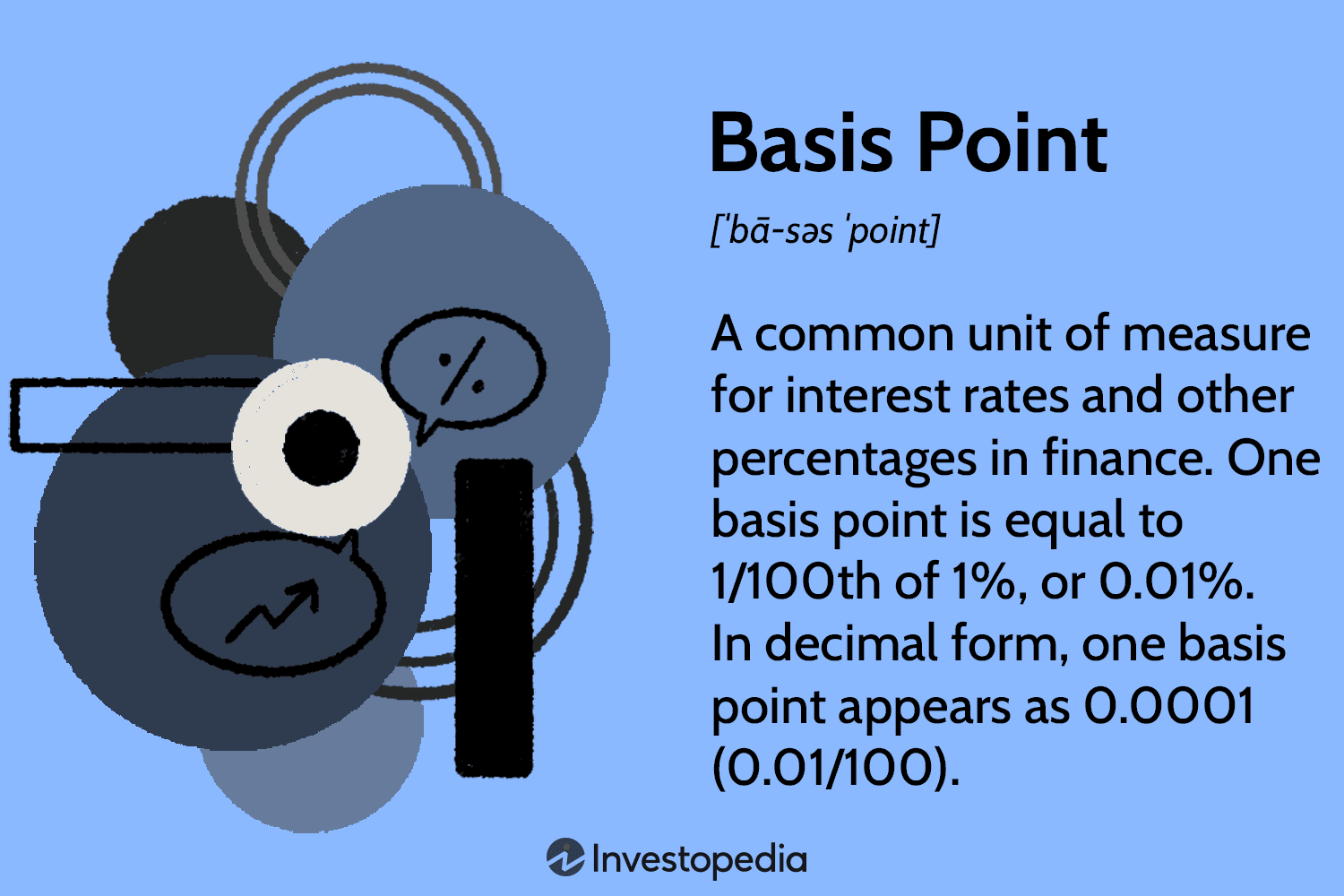
One basis point is 0.01% or 1/100th of 1%. This value is mathematically fixed; it does not vary with markets or economic conditions.
How Do You Convert Between Basis Points and Percentages?
It’s easy to convert percentages to basis points and vice versa. One basis point is equivalent to 0.01% or 1/100th of a percent. For a basis point conversion to a percentage, all you need to do is divide the basis points by 100. Conversely, to convert a percentage to basis points, multiply the percentage by 100.
The Bottom Line
Basis points are a common unit of measurement in finance. A basis point is 1/100th of 1% and is commonly used to indicate interest rates or changes in rates in bonds and other financial instruments.
[ad_2]
Source link


