

[ad_1]
What Is Currency?
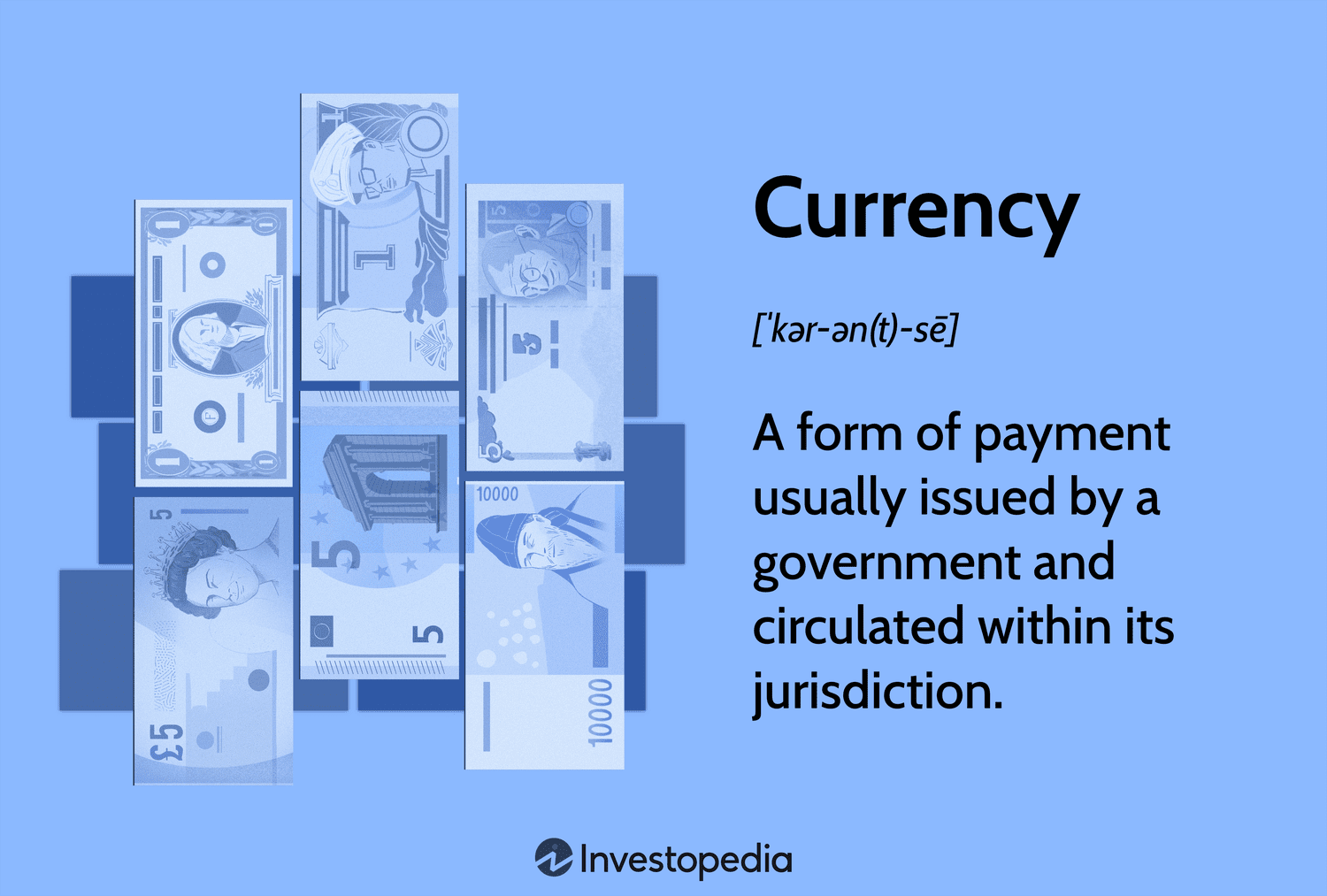
Currency is a medium of exchange accepted and used globally in transactions for goods and services. It is a tangible form of the concept of money, and has evolved from bartering to modern-day paper and coin forms to include virtual currencies like cryptocurrencies. Countries have their own currencies and they constantly change in relation to each other. Some countries peg their currency value directly to the U.S. dollar.
Key Takeaways
- Currency is a physical form of money, including coins and paper notes, issued by governments worldwide.
- Cryptocurrencies like Bitcoin are modern digital currencies without physical form or government backing.
- Money refers to an intangible system of value, while currency is money’s tangible form.
- The exchange rate of a currency fluctuates with global economic and political events.
- There are more than 200 national currencies, with the U.S. dollar often used internationally or pegged by other countries.
The Role and Characteristics of Modern Currency
Currencies have been used for at least 3,000 years. Initially, only coins existed, helping trade across continents.
Modern currency lacks intrinsic value. Bills are just paper, unlike coins made from gold, silver, or bronze.
China might have developed paper currency by 1000 B.C.E., but it took time for people to accept and exchange it for real value. Modern currencies are issued on paper in various denominations, with fractional issues in the form of coins.
Distinguishing Money from Currency
The terms money and currency are often thought to mean the same thing. However, while related, they have different meanings.
Money is a broader term that refers to an intangible system of value that makes the exchange of goods and services possible, now and in the future. Currency is simply one tangible form of money.
Money is used in a variety of ways, all related to its future use in some kind of transaction. For example, money is a store of value. This means that it has and maintains a certain value that supports ongoing exchanges. People know that the money they received today essentially will have the same value next week when they need to make a purchase or pay a bill.
Money is also referred to as a unit of account. That means it can be used to account for changes in the value of items over time. Businesses use money as a unit of account when they prepare a budget or give assets a value. Profits and losses are established and relied upon using money as a unit of account.
Money also has certain properties that allow for the smooth exchange of goods:
- It is fungible, or exchangeable, so it doesn’t need to be re-valued for every transaction.
- It is durable so it lasts for many exchanges over time.
- It is convenient to carry and divide.
- It is recognizable so that people can trust it and confidently complete their exchanges of goods and services.
- The supply of money should be stable so that its value is reliable.
Understanding what money is clarifies the meaning of currency. It’s a form of money used every day by people all over the world. Checks are another form of money, known as money substitutes. Cigarettes have even been a form of money, as they were for soldiers during the Second World War.
Fast Fact
The Bureau of Engraving and Printing is responsible for printing America’s paper currency. Its parent agency is the U.S. Department of the Treasury. The U.S. Mint, founded in 1792, is “the nation’s sole manufacturer of legal tender coinage and is responsible for producing circulating coinage for the nation to conduct its trade and commerce.”
Exploring Different Forms of Currency
The United States Mint defines currency as money in the form of paper and coins that’s used as a medium of exchange. Currencies are created and distributed by individual countries around the world.
U.S. currency in paper form is issued by the Bureau of Engraving and Printing as $1, $2, $5, $10, $20, $50, and $100 bills. The $500, $1,000, $5,000, and $10,000 bills are no longer issued but those still in circulation are redeemable at full face value. Currency issued in 1861 or earlier is no longer valid and would not be redeemable at full face value.
U.S. currency in the form of coins is issued by the Mint in denominations of 1¢, 5¢, 10¢, 25¢, 50¢, and $1.
There are over 200 national currencies currently in circulation. Including the U.S., 42 countries either use the U.S. dollar or peg their currencies directly to the dollar. According to the International Monetary Fund (IMF) the dollar makes up 58.8% of the foreign exchange reserves.
Most countries issue their currencies, like Switzerland’s franc and Japan’s yen. The euro, used by many European Union countries, is an exception.
Some countries accept the U.S. dollar as legal tender in addition to their own currencies, like the Bahamas, Zimbabwe, and Panama. For some time after the founding of the U.S. Mint in 1792, Americans continued to use Spanish coins because they were heavier and presumably felt more valuable.
There are also branded currencies, like airline and credit card points. These are issued by companies and are used only to pay for the products and services to which they are tied.
Understanding Currency Trading and Exchange Rates
The exchange rate is the current value of any currency relative to another currency. As a result, rates are quoted for currency pairs, such as the EUR/USD (euro to U.S. dollar). Exchange rates fluctuate constantly in response to economic and political events.
These fluctuations create the market for currency trading. The foreign exchange market where these trades are conducted is one of the world’s largest markets, based on sheer volume. All trades are in large volumes, with a standard minimum lot of 100,000. Most currency traders are professionals investing for themselves or for institutional clients that include banks and large corporations.
The foreign exchange market has no physical address. Trading is entirely electronic and goes on 24 hours a day to accommodate traders in every time zone.
For most people, currency exchange typically is done at an airport kiosk or a bank before we go on a trip or while traveling.
Consumer advocates say that travelers get the best value by exchanging cash at a bank or at an in-network ATM. Other options may have higher fees and unattractive exchange rates.
What Does Currency Mean?
The term currency refers to the tangible form of money that is paper bills and coins. It’s used as a medium of exchange that’s accepted at face value for products and services as well as for savings and the payment of debt.
What’s an Example of Currency?
One example of currency is any of the U.S. paper bills you may have on hand. It is any of the coins the U.S. issues, such as the penny, nickel, and quarter. Currency can also be the paper bills and coins issued by the governments of other countries across the globe.
What’s the Difference Between Money and Currency?
Money is an intangible system of value that provides the means for the ongoing exchange of goods and services in a society. Money has taken many forms since it overtook the system of bartering. Currency is a tangible form of it. So, instead of, say, bartering agricultural produce for the clothing you may need, you can use currency—paper notes and coins—to obtain it.
The Bottom Line
Currency is a medium of exchange and long ago replaced the barter system to facilitate efficient trade in goods and services. It embodies fungibility, durability, portability, and recognizability, making it a trusted payment form for exchanges. While currency is a tangible form of money, money itself is an intangible system of value used for various economic functions. There are over 200 national currencies, and the U.S. dollar in particular plays a significant role in international trade and foreign reserves. In the 21st century, cryptocurrencies—which have no physical form and are not issued by the government—have become popular.
[ad_2]
Source link


