[ad_1]
What Is a Closed-End Fund?
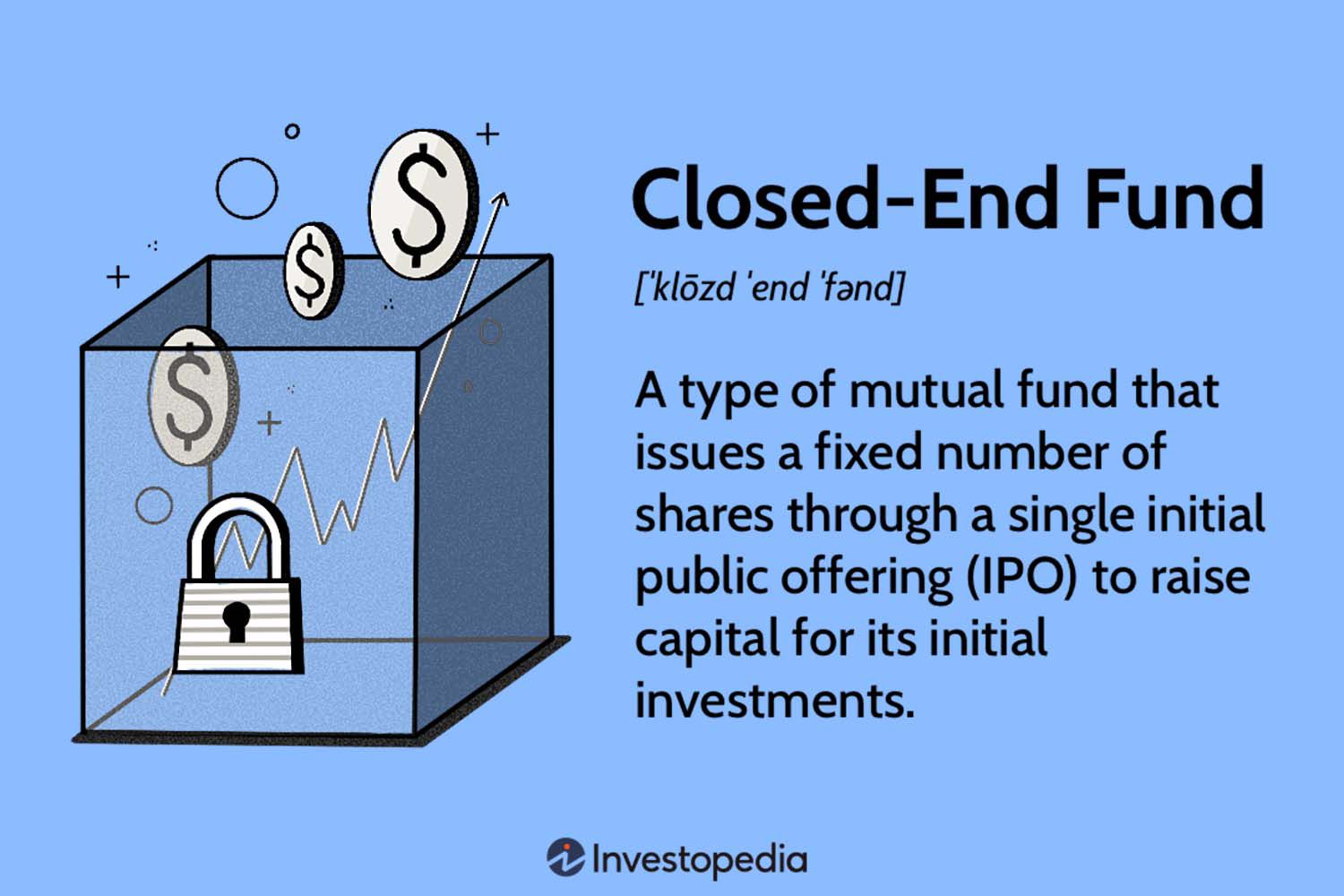
A closed-end fund sells a set number of shares once through an initial public offering (IPO) to raise investment capital. These shares are then traded on a stock exchange, with no new shares being issued or new money added to the fund.
In contrast, an open-end fund, such as most mutual funds and exchange-traded funds (ETFs), accepts a constant flow of new investment capital. It issues new shares and buys back its own shares on demand.
Many municipal bond funds and some global investment funds are closed-end funds.
Key Takeaways
- Closed-end funds issue a fixed number of shares in a one-time IPO and trade on stock exchanges, unlike open-end funds, which continuously issue and redeem shares.
- These funds can trade at a premium or discount to their net asset value due to market conditions, offering potential opportunities for investors.
- Closed-end funds often use leverage to enhance returns, which can lead to higher potential rewards and risks compared to open-end funds.
- While closed-end funds might offer higher yields, they are less liquid than open-end funds and largely available only through brokers.
Navigating the Dynamics of Closed-End Funds
Like many mutual funds, a closed-end fund has a manager overseeing the portfolio and actively buying, selling, and holding assets.
Like stocks and ETFs, closed-end fund shares change prices during the trading day. The parent company does not issue more shares, and the fund does not repurchase shares, except in the case of interval funds, which can buy back shares.
Closed-end funds and open-end mutual funds have many similarities. Both make distributions of income and capital gains to their shareholders. Both charge an annual expense ratio for their services. Moreover, the companies that offer them must be registered with the Securities and Exchange Commission (SEC).
Comparing Closed-End and Open-End Funds
Closed-end funds differ from open-end funds in key ways. They raise a set amount of capital by selling a fixed number of shares in a single offer. After selling all shares, the fund closes.
Most mutual and exchange-traded funds constantly accept new investor dollars, issuing additional shares, and redeeming—or buying back—shares from shareholders who wish to sell.
A closed-end fund lists on a stock exchange where the shares trade like stocks throughout the trading day.
Open-end mutual funds price their shares once daily, at the close of trading, based on the portfolio’s net asset value. The stock price of a closed-end fund fluctuates according to the usual forces of supply and demand and the changing values of the fund’s holdings.
Closed-end funds trade only in secondary markets, needing a brokerage account for transactions. Open-end funds are typically bought directly from their sponsoring company.
Cons
-
Subject to volatility
-
Less liquid than open-end funds
-
Available only through brokers
-
May get heavily discounted
How Net Asset Value (NAV) Impacts Closed-End Funds
Pricing is a unique feature of closed-end funds. The fund’s NAV is calculated regularly based on its asset value. However, the price that it trades for on the exchange is market-driven. This means a closed-end fund can trade at a premium or a discount to its NAV. A premium price means the price of a share is above the NAV, while a discount is the opposite, below the NAV.
There are several reasons for this. A fund’s market price may rise because it is focused on a sector currently popular with investors or because its manager is well-regarded among investors. Or, a history of underperformance or volatility may make investors wary of the fund, driving down its share value.
Evaluating the Performance of Closed-End Funds
Closed-end funds do not repurchase their shares from investors. That means they don’t have to maintain a large cash reserve level, leaving them with more money to invest.
They can also make heavy use of leverage—borrowed money—to boost their returns.
This allows closed-end funds to potentially offer higher returns than open-end mutual funds.
Exploring Examples of Notable Closed-End Funds
There are many different types of closed end funds. These can include business development companies (BDCs), real estate funds, commodity funds, and bond funds. The largest type of closed-end fund, as measured by assets under management, is the municipal bond fund. These large funds invest in the debt obligations of state and local governments and federal government agencies. Managers of these funds often seek broad diversification to minimize risk but may also rely on leverage to maximize returns.
Managers also build closed-end global, international, and emerging markets funds that mix stocks and fixed-income instruments.
Fast Fact
Global funds combine U.S. and international securities. International funds purchase only non-U.S. securities. Emerging markets funds focus on fast-growing and volatile foreign sectors and regions.
One of the largest closed-end funds is the Eaton Vance Tax-Managed Global Diversified Equity Income Fund (EXG). Founded in 2007, it had total net assets of $2.7 billion as of Dec. 31, 2023. The primary investment objective is to provide current income and gains, with a secondary objective of capital appreciation.
What Are the Advantages of a Closed-End Fund?
Shares of a closed-end fund trade throughout the day on a stock exchange, and that market-driven price may differ from its NAV. This can provide opportunities for profiting from higher or lower values.
How Are Closed-End Funds Different From Open-End Funds?
An open-end mutual fund issues new shares whenever an investor chooses to buy into it and repurchases them when they’re available. A closed-end fund issues shares only once. Closed-end funds also tend to use leverage, or borrowed money, to boost their returns to investors. That means higher potential rewards in good times and higher potential risks in bad times.
What Is the Downside to Closed-End Funds?
One of the significant downsides to closed-end funds is that no new shares are issued. So, to gain access to a closed-end fund, you’d have to find someone willing to sell shares at a premium or wait until some open up on the market.
The Bottom Line
Closed-end funds are funds that only issue shares once. When they are all sold, there are no more available unless an owner decides to sell them. Closed-end funds are generally priced by their net asset value, but prices fluctuate throughout a trading day because they are actively traded.
[ad_2]
Source link