[ad_1]
:max_bytes(150000):strip_icc():format(webp)/DavidRubinbiophoto-720c26a0862f4b3e86e1d2036ffcf10f.jpg)
:max_bytes(150000):strip_icc():format(webp)/black-money.asp-FINAL-1-8bc0d9ee1f4f40c08da92910dbd5b478.png)
Investopedia / Joules Garcia
What Is Black Money?
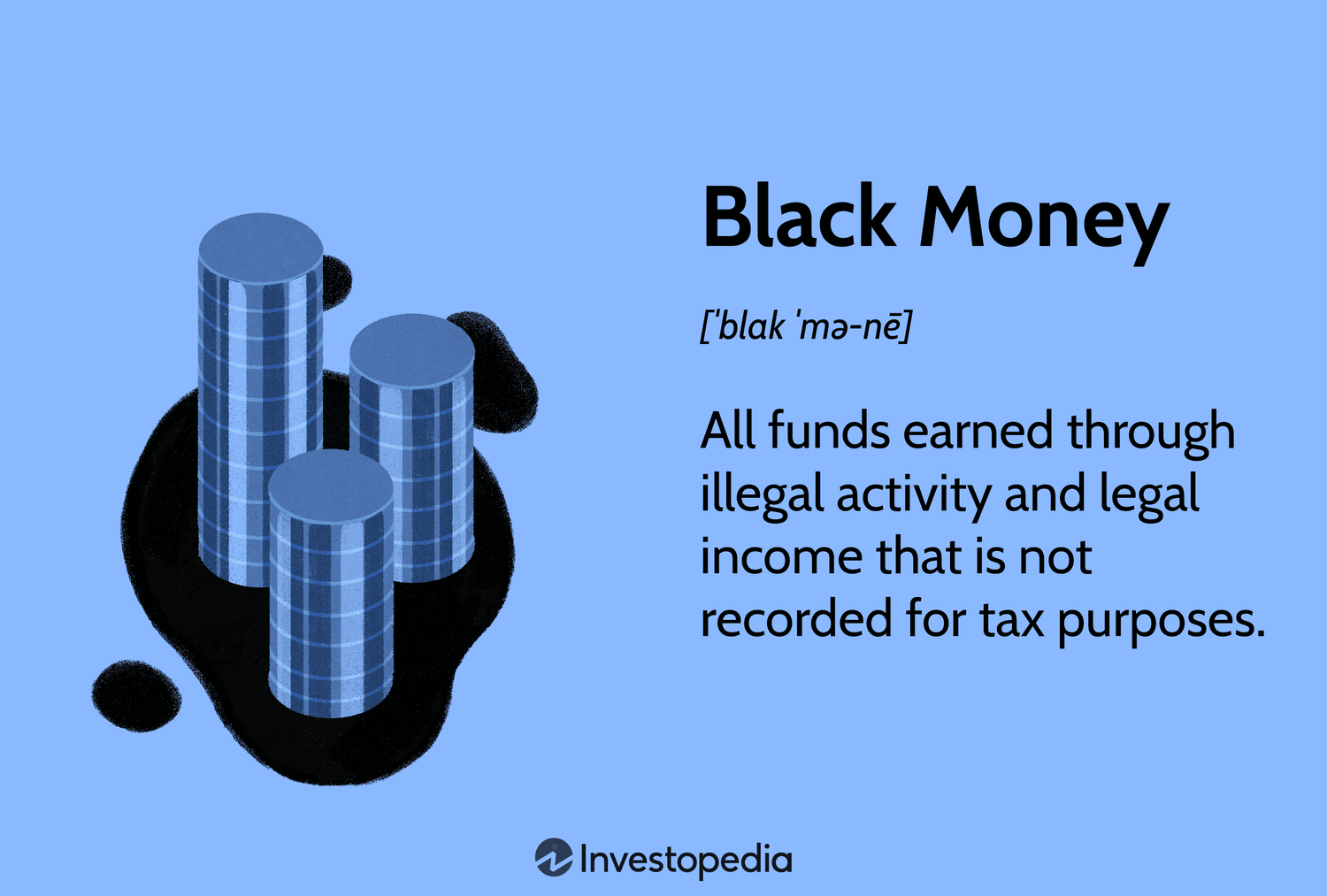
Black money is comprised of funds obtained through illegal activities or income not declared for tax purposes. Typically received in cash, this unreported income is part of the underground economy. Black money recipients often attempt to hide it, spend it within the underground economy, or launder it to appear legitimate. This economic activity can lead to significant government revenue losses and increased corruption.
Key Takeaways
- Black money consists of income earned through illegal activities or legal income that is not declared for tax purposes.
- Black money can lead to increased corruption and financial instability in an economy due to its unreported nature.
- It is often transacted in cash and may result in financial leakage, depriving governments of tax revenue needed for public services.
- While illegal, black money can sometimes offer economic relief in oppressive regimes by bypassing restrictive laws.
- Money laundering is commonly used to convert black money into legal funds, often involving complex methods like the hawala system.
Understanding the Mechanics of Black Money
In its simplest form, black money is money on which tax is not paid to the government. Suppose a store accepts cash for its merchandise and does not issue receipts to its customers. That store is transacting in black money, as it would not pay tax on the unrecorded sales. As another example, consider a property buyer who purchases land valued at $200,000. If the buyer only reports $50,000 on the books and pays $150,000 under the table, then there is a black money transaction worth $150,000. The sellers in both examples have earned money from legal sources but evaded taxes.
The most common source of black money is the black market or underground economy. Activities in the black market may include selling prohibited drugs, gunrunning, terrorism, and human trafficking. Black market activities also involve less severe offenses, such as the sale of counterfeit goods, stolen credit cards, or pirated versions of copyrighted material.
Black money affects a country’s economic growth by causing financial leakage, leading to lost government revenue from untaxed income. In addition, these funds rarely enter the banking system. As a result, it can be more difficult for legitimate small businesses and entrepreneurs to obtain loans.
Moreover, black money makes a nation’s financial health seem weaker because it’s hard to measure. Participants in the underground economy work hard to hide their activities. Since unreported earnings are not part of a country’s GNP or GDP, estimates of savings, consumption, and other macroeconomic data can be misleading, impacting planning and policymaking.
Challenges and Criticisms Surrounding Black Money
Black money, along with immoral activities like human trafficking, creates problems. High levels of black money often lead to more corruption. Businesses profiting in the underground economy often bribe law enforcement to overlook offenses, which can result in a corrupt police force participating in crimes.1
Unexpected Benefits of Black Money
Black money produces the most benefits in societies with the most oppressive laws. For example, many ordinary market economic transactions were illegal in the Soviet Union. People turned to the underground economy to alleviate shortages and obtain banned goods.2 In many other cases, regimes imposed price controls that made goods unobtainable or sales taxes that made them unaffordable. Black money provided a way to decrease the damage.
Black money can also help to reduce the impact of systematic racism. Historically, governments banned certain races from holding land, trading securities, or otherwise exercising their natural rights to engage in commerce. These bans pushed some victims of discrimination into less regulated areas where they were free to earn black money.
Key Considerations When Dealing with Black Money
Most black money holders attempt to convert the money into legal money, also known as white money. There are a number of ways to do that.
Important
The penalties against money laundering are often severe, so legitimate businesses must be careful to avoid accidentally participating in it.
Money laundering can be perpetrated using the hawala system of transactions. The hawala system is an informal and cheap method of transferring money from one region to another without any actual money movement and without the use of banks. It operates on codes and contacts, and no paperwork or disclosure is required. If a money launderer in the U.S. decides to send $20,000 through a hawala dealer to a recipient in India, the exchange rate agreed upon will be fixed at a significantly higher rate than the official rate.
Tax havens can offer anonymity to money launderers due to the lax policies on funds deposited in their countries. Other outlets for black money include real estate, jewelry, cash, bullion investments, and cryptocurrencies.
The Bottom Line
Black money significantly impacts economies through tax evasion, promoting corruption, and influencing the underground economy. Despite its association with illicit activities, such as money laundering, black money can sometimes offer benefits, particularly in oppressive regimes where it helps people overcome economic limitations. However, participating in or benefiting from black money can lead to severe legal consequences. Understanding the complexities of black money and its effect on national economies can help individuals and policymakers devise more effective strategies to curb its prevalence.
[ad_2]