[ad_1]
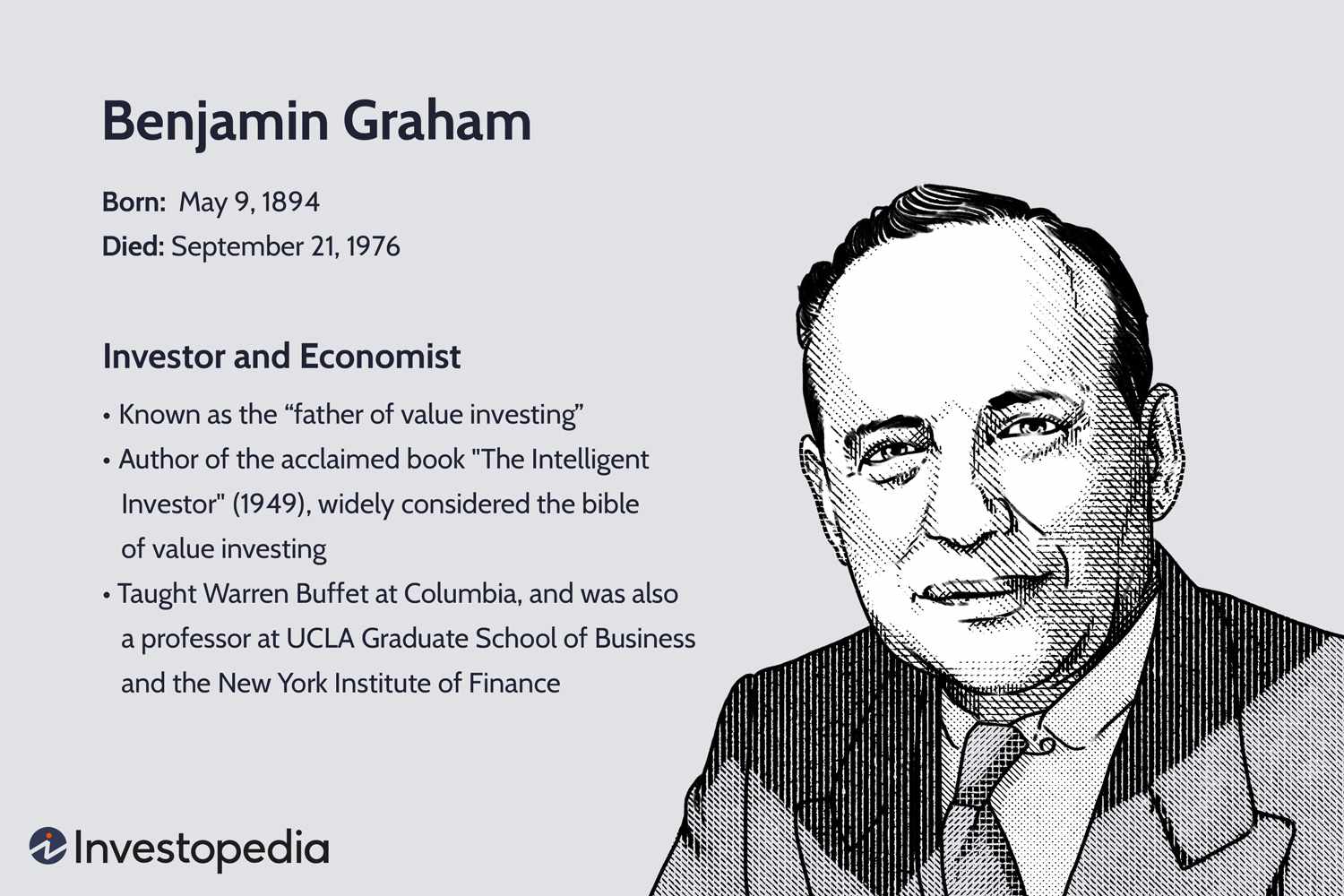
Benjamin Graham was a key investor in the early 20th century. His work in securities formed the basis for the detailed stock analysis methods used by investors today. His famous book, “The Intelligent Investor”, has gained recognition as the foundational work in value investing.
Key Takeaways
- Benjamin Graham is known as the father of value investing and authored “The Intelligent Investor.”
- Graham’s approach emphasizes buying undervalued stocks to gain a margin of safety.
- He mentored Warren Buffett, one of the world’s most successful investors.
- His work laid the foundation for modern stock analysis using intrinsic value.
- Graham’s investment principles include maintaining a margin of safety and capitalizing on market volatility.
Benjamin Graham’s Formative Years and Education
Benjamin Graham was born in 1894 in London, UK. When he was still little, his family moved to America, where they lost their savings during the Bank Panic of 1907. Graham attended Columbia University on a scholarship and accepted a job offer after graduation on Wall Street with Newburger, Henderson, and Loeb.
By the age of 25, he was already earning about $500,000 annually. The Stock Market Crash of 1929 lost Graham almost all his investments and taught him some valuable lessons about the investing world. His observations after the crash inspired him to write a research book with David Dodd, called “Security Analysis”. Irving Kahn, one of the greatest American investors, also contributed to the research content of the book.
Benjamin Graham: Pioneering Achievements in Investing
The Foundations of Value Investing
Benjamin Graham is considered a founder of stock analysis and in particular of value investing. According to Graham and Dodd, value investing is deriving the intrinsic value of a common stock independent of its market price, then comparing that to the stock’s market value. The intrinsic can be found using a company’s financial fundamentals, including its:
If the intrinsic value is more than the current price, the investor should buy and hold until a mean reversion occurs. A mean reversion is the theory that over time, the market price and intrinsic price will converge towards each other until the stock price reflects its true value. By buying an undervalued stock, the investor pays less for it than it is worth, then sells when the price is trading at its intrinsic worth.
This effect of price convergence is only bound to happen in an efficient market. Graham was a strong proponent of efficient markets. If markets were not efficient, then value investing would be pointless: the fundamental principle of value investing lies in the ability of the markets to eventually correct to their intrinsic values. Common stocks are not going to remain inflated or bottomed out forever despite the irrationality of investors in the market.
Graham observed that investor irrationality, market unpredictability, and stock fluctuations make buying undervalued stocks a safe strategy.
Investors can ensure safety by buying stocks with high dividends, low debt, and by diversifying their investments. In the event that a company goes bankrupt, the margin of safety would mitigate the losses that the investor would have. Graham normally bought stocks trading at two-thirds their net-net value as his margin of safety cushion.
The original Benjamin Graham Formula for finding the intrinsic value of a stock was:
V
=
E
P
S
×
(
8.5
+
2
g
)
where:
V
=
intrinsic value
E
P
S
=
trailing 12-mth
E
P
S
of the company
8.5
=
P
/
E
ratio of a zero-growth stock
g
=
long-term growth rate of the company
\begin{aligned}&V \ =\ EPS \ \times\ (8.5\ +\ 2g)\\&\textbf{where:}\\& V\ =\ \text{intrinsic value}\\&EPS\ =\ \text{trailing 12-mth } EPS\text{ of the company}\\&8.5\ =\ P/E\text{ ratio of a zero-growth stock}\\&g\ =\ \text{long-term growth rate of the company}\end{aligned}
V = EPS × (8.5 + 2g)where:V = intrinsic valueEPS = trailing 12-mth EPS of the company8.5 = P/E ratio of a zero-growth stockg = long-term growth rate of the company
In 1974, the formula was revised to include both a risk-free rate of 4.4% which was the average yield of high grade corporate bonds in 1962 and the current yield on AAA corporate bonds represented by the letter Y:
V
=
E
P
S
×
(
8.5
+
2
g
)
×
4.4
Y
V=\frac{EPS\ \times\ (8.5\ +\ 2g)\ \times\ 4.4}{Y}
V=YEPS × (8.5 + 2g) × 4.4
Graham’s Influential Works on Investing
Security Analysis was first published in 1934 at the start of the Great Depression, while Graham was a lecturer at Columbia Business School. The book laid out the fundamental groundwork of value investing, which involves buying undervalued stocks with the potential to grow over time. At a time when the stock market was known to be a speculative vehicle, the notion of intrinsic value and margin of safety, which were first introduced in “Security Analysis”, paved the way for a fundamental analysis of stocks void of speculation..
In 1949, Graham wrote the acclaimed book “The Intelligent Investor: The Definitive Book on Value Investing”. This work is widely considered the bible of value investing and features a character known as Mr. Market, Graham’s metaphor for the mechanics of market prices.
Mr. Market is an imaginary partner who daily offers to buy or sell shares to the investor. Mr. Market is often irrational and shows up at the investor’s door with different prices on different days depending on how optimistic or pessimistic his mood is. Of course, the investor is not obligated to accept any buy or sell offers.
Graham points out that instead of relying on daily market sentiments, which are driven by investors’ emotions of greed and fear, investors should analyze a stock’s worth based on the company’s reports of its operations and financial position. This analysis should strengthen the judgment of the investor when they are made an offer by Mr. Market.
Graham advised selling to optimists and buying from pessimists. Look for chances to buy low and sell high during market shifts or publicity issues. If no such opportunity is present, the investor should ignore the market noise.
While echoing the fundamentals introduced in “Security Analysis”, “The Intelligent Investor” also provides key lessons to readers and investors by advising investors to:
- Not follow the herd or crowd
- Hold a portfolio of 50% stocks and 50% bonds or cash
- Be wary of day trading
- Take advantage of market fluctuations
- Not buy a stock simply because it is popular
- Understand that market volatility is a given and can be used to an investor’s advantage
- Look out for creative accounting techniques that companies use to make their EPS value more attractive
The Enduring Legacy of Benjamin Graham
One notable disciple of Benjamin Graham is Warren Buffett, who was one of his students at Columbia University. After graduation, Buffett worked for Graham’s company, Graham-Newman Corporation, until Graham retired. Buffett, under the mentorship of Graham and value investing principles, went on to become one of the most successful investors of all time and as of January 2024, the eighth wealthiest man in the world valued at almost $120.6 billion. Other notable investors who studied and worked under the tutelage of Graham include Irving Kahn, Christopher Browne, and Walter Schloss.
Although Benjamin Graham died in 1976, his work lives on and is still widely used by value investors and financial analysts running fundamentals on a company’s prospect for value and growth.
What Is the Dodd and Graham Award?
The Graham and Dodd Award, in honor of former Columbia University finance professors Benjamin Graham and David Dodd, acknowledges people who excel in research and financial writing in the Financial Analysts Journal.
What Is Benjamin Graham Known for?
Benjamin Graham was a renowned value investor, lecturer, financial securities researcher, and mentor to billionaire investor Warren Buffett. Known as the “father of investing,” Graham wrote several books, including “The Intelligent Investor”, which is widely considered the value investor’s bible.
What Are the 3 Principles of Investment According to Benjamin Graham?
The Bottom Line
Benjamin Graham, dubbed the “father of value investing,” became famous for his investing style, literary contributions on investing, and research. Graham lectured at his alma mater, Columbia University, and eventually became a professor of finance there. His legendary book, “The Intelligent Investor”, introduced value investing to the financial and investing world. He also defined investment principles adopted by some of the world’s most infamous investors.
[ad_2]