

[ad_1]
What Is Depreciation?
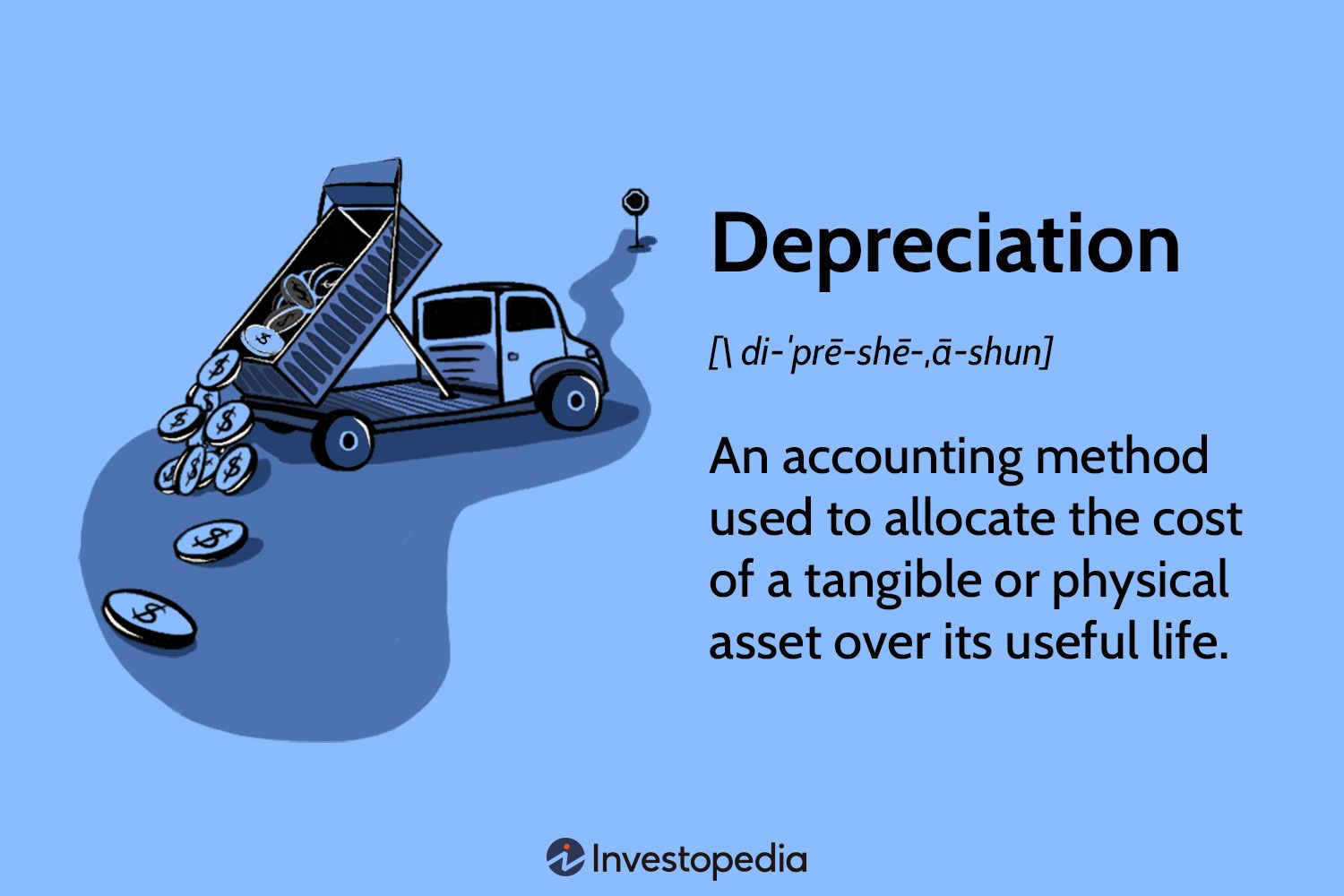
Depreciation is a crucial accounting practice that spreads the cost of expensive assets, like equipment, across their useful life. This helps businesses avoid the appearance of financial loss from large upfront expenses and matches the cost of assets with the revenue they generate over time. Discover the importance of depreciation, how it reflects on a company’s financial health, and learn about common methods like straight-line and accelerated depreciation.
Key Takeaways
- Depreciation is an accounting method that allocates the cost of a tangible asset over its useful life to reflect its decreasing value through use and obsolescence.
- The primary purpose of depreciation is to match the cost of an asset to the revenue it generates over time, improving the accuracy of financial statements.
- Various methods of depreciation, such as straight-line, declining balance, and double declining balance, allow companies to choose the approach that best matches their financial and tax strategies.
- Depreciation helps businesses track the value of their assets, manage taxes efficiently, and plan for future replacements by spreading expenses over multiple years.
- Not all assets qualify for depreciation; for instance, land is not depreciated as it is considered to have an unlimited useful life.
Understanding the Basics of Depreciation
When companies invest heavily in physical assets, how should they record these large expenses? Rather than taking the full hit upfront, depreciation lets businesses spread these costs across the years they’ll use the equipment.
Here’s a breakdown of the main concepts involved:
- Tangible asset: Depreciation applies to physical assets expected to last for more than one year (often called fixed assets or capital assets). Land is not depreciated since it’s considered to have an unlimited useful life.
- Useful life: This is the estimated period of time that the equipment will be productive for the business, which isn’t necessarily how long the equipment will last. Instead, it’s the period it’s expected to be used by that specific business. Useful life is often dictated by accounting standards or tax regulations.
- Cost: This includes the purchase price and any expenses to get the asset ready for use (e.g., shipping, installation, and setup).
Depreciation shifts these costs from the company’s balance sheet to the income statement.
Why Depreciation Is Important
Here are the core reasons depreciation is a crucial part of modern accounting methods:
- The matching principle: This longstanding principle in accounting means that expenses should be recognized in the same period as the revenues they help generate.
- A better depiction of a company’s financial position: It gives a clearer view of a company’s financial health and performance.
- Tax benefits: Depreciation is a tax-deductible expense. This reduces taxable income and, therefore, the amount of tax a company owes.
- Managing company assets: Depreciation helps businesses track the value of their assets and plan for future replacements.
How Depreciation Affects Financial Statements
Although a company pays cash upfront for equipment, depreciation spreads this cost over several financial statements.
Companies normally must follow generally accepted accounting principles issued by the Financial Accounting Standards Board when recording depreciation. These standards require matching expenses with related revenue. So, if a machine helps make products for five years, its cost should be spread across those five years rather than hitting the books all at once.
Guidelines for Establishing Depreciation Thresholds
Most businesses set minimum amounts to decide if they should depreciate an asset or expense it immediately. A small business might set this threshold at $500, while larger corporations often use higher limits like $5,000 or $10,000. It’s not worthwhile to depreciate every purchase due to time and accounting costs.
Evaluating Asset Value Through Depreciation
These aspects of depreciation are used to track an asset’s value over time:
- Accumulated depreciation: This is the total depreciation amount since the asset was purchased. So, if a $50,000 machine depreciates $10,000 annually, its accumulated depreciation would be $30,000 after three years.
- Carrying value (or book value): This represents what’s left after subtracting accumulated depreciation from the original cost. In our example, the machine’s carrying value would be $20,000 after three years.
- Depreciable base (or depreciable cost): It’s not the original cost (purchase price plus delivery, etc.) used for calculating depreciation, but the depreciation base. It’s calculated as follows: Cost – Salvage Value = Depreciable Base.
- Depreciation rate: This is the annual percentage at which an asset is depreciated over its useful life. For example, if a company expects an asset to depreciate $1,000,000 over its lifetime and the annual depreciation is $200,000, the depreciation rate is 20%.
- Salvage value (or residual value): This is what the company expects to receive for the asset if it’s sold, scrapped, or traded in. Generally, the longer the useful life, the lower the residual value; sometimes, the salvage value is zero.
Tip
Not all assets qualify for depreciation. For instance, while Microsoft can depreciate its AI servers and the buildings that hold them, it can’t depreciate the land underneath them.
Comparing Carrying Value to Market Value
While carrying value tracks depreciation on the books, it often differs significantly from what an asset would actually sell for—its market value. Consider Microsoft’s data centers: Their carrying value might show steady depreciation over time, but their market value could be higher because of the surging demand for AI infrastructure, or lower if newer, more efficient technology makes them obsolete faster than expected. Therefore, the gap between carrying value and market value can be large.
Navigating Depreciation for Tax Benefits
Companies use depreciation to reduce their tax bills with the IRS. For example, when Microsoft invests $80 billion in AI infrastructure, it will deduct portions of those purchases each year, lowering its corporate tax bill.
The tax code generally requires companies to spread these deductions across multiple years, matching how they expect to use the asset. (Section 179 of the tax code offers businesses some flexibility—in some cases, they can deduct the entire cost of qualifying equipment in the first year.)
These are the criteria the IRS has set for what can be depreciated:
- Be owned by the business (not leased)
- Be used for business or income-producing activities
- Have a useful life that can be calculated
- Be expected to last more than a year
- Not fall under excluded categories, such as intangible property (these are generally amortized) or equipment used for building capital improvements
Important
The IRS publishes schedules giving the number of years over which different types of assets can be depreciated for tax purposes.
Exploring Depreciation Methods With Examples
Companies can choose from several methods to depreciate their assets. To demonstrate, we’ll use the example of a company purchasing a $50,000 computer server with an expected useful life of five years and a $5,000 salvage value.
Straight-Line Method
The straight-line method is the simplest and most common. It spreads the cost evenly across an asset’s life. Using the above figures, we get the following:
- Total depreciation: $45,000 ($50,000 – $5,000 salvage value)
- Annual depreciation: $9,000 ($45,000 ÷ 5 years)
- Depreciation rate: 20% (1 ÷ 5 years = 0.20 or 20% per year)
Declining Balance
The declining balance method accelerates depreciation by using the straight-line percentage (20% in our example) and applying it to the remaining balance:
- Year 1: $10,000 ($50,000 × 20%)
- Year 2: $8,000 ($40,000 × 20%)
- Year 3: $6,400 ($32,000 × 20%)
Double-Declining Balance
This method doubles the declining balance rate (20%), front-loading even more depreciation:
- Year 1: $20,000 ($50,000 × 40%)
- Year 2: $12,000 ($30,000 × 40%)
- Year 3: $7,200 ($18,000 × 40%)
Sum-of-the-Years’ Digits (SYD)
The SYD method also accelerates depreciation but is calculated differently. For a five-year asset, add years 1+2+3+4+5 = 15. Then use these fractions against the depreciable amount ($45,000):
- Year 1: $15,000 ($45,000 × 5/15), using the highest number first
- Year 2: $12,000 ($45,000 × 4/15), second largest number
- Year 3: $9,000 ($45,000 × 3/15), and so on
Units of Production
This method accounts for usage rather than time. If the server is expected to process 1 million computations in its lifetime, you might get something like the following:
- Depreciation per computation = $45,000 ÷ 1,000,000 = $0.045
- If it processes 300,000 computations in Year 1, depreciation would be $13,500 (300,000 × $0.045)
The Bottom Line
Depreciation plays a pivotal role in accurately representing a company’s financial performance and tax liabilities. By spreading the cost of substantial investments like AI infrastructure or manufacturing equipment over their useful life, companies can align expenses with the revenue they generate, offering a clearer picture of financial health.
Depreciation methods such as straight-line and accelerated depreciation provide varying approaches to reflect asset value over time. Understanding these methods is essential for certain business owners and investors as they can substantially influence reported earnings and tax obligations, particularly in industries that heavily invest in physical assets.
[ad_2]


