

[ad_1]
What Is a Deposit?
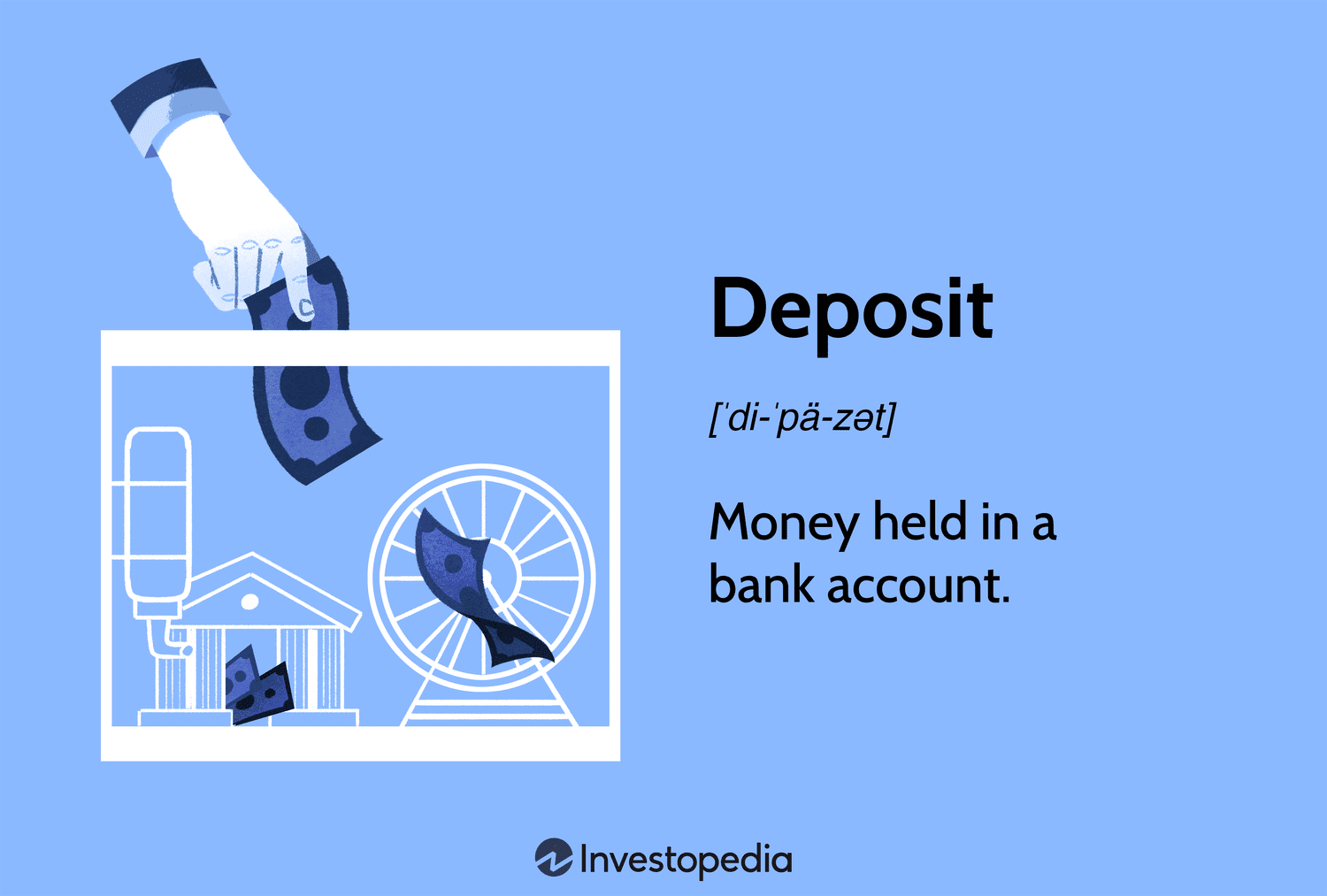
A deposit is money kept in a bank account or other financial institution, transferred between parties. A deposit can also be money used as security or collateral for goods or services.
In banking, the main types are demand deposits, which can be withdrawn at any time, and time deposits, which are more limited. These provide financial security to the depositor while also allowing them to earn some interest.
Key Takeaways
- Deposits can serve dual purposes: they can simply be transferred to a bank for safekeeping or be utilized as collateral to secure loans or services.
- There are two primary types of deposits: demand deposits, which allow for immediate withdrawal of funds, and time deposits, which require funds to be held for a set period and typically offer higher interest rates.
- The process of making deposits involves transferring money into accounts such as checking accounts, which may come with requirements like minimum deposits or can be used to earn interest under certain conditions.
- Deposits are common in various financial transactions, including large purchases and rental agreements, where they may act as down payments or security deposits, ensuring the condition of the rented property or item.
Understanding How Deposits Function
A deposit is essentially your money that you transfer to another party, such as when you move funds into a checking account at a bank or credit union.
In the case of depositing money into a bank account, you can withdraw the money anytime, transfer it to another person’s account, or use it to make purchases.
Banks might also offer the creation of separate business accounts. Business banking—also called corporate or commercial banking—is designed to meet the needs of businesses. They allow for deposits and withdrawals, as with personal accounts, but often have different limits. Some business accounts will allow employees to deposit or withdraw funds. Banks that offer business accounts frequently have night depositories, which are secured lockboxes that allow users to deposit cash and checks when the bank is closed.
Often, you must deposit a certain amount of money, called the minimum deposit, to open a new bank account. Depositing money into a checking account is a transaction deposit, meaning the funds are immediately available and can be withdrawn without delay.
The other definition of deposit is when a portion of funds is used as a security or collateral for the delivery of a good. Some contracts require a percentage of funds paid upfront as an act of good faith. For example, brokerage firms often require traders to make an initial margin deposit to enter into a new futures contract.
Important
Depositing money into some bank accounts can earn you interest. This means that, at fixed intervals, a small percentage of the account’s total is added to the amount of money already in the account. Interest can compound at different rates and frequencies, depending on the terms of the bank.
Exploring Different Types of Deposits
There are two main types of deposits: demand and time.
- Demand deposit: A demand deposit is a conventional bank checking or savings account. You can withdraw the money anytime from a demand deposit account without advance notice.
- Time deposits: Time deposits are those with a fixed time and usually pay a fixed interest rate, like a certificate of deposit (CD). These interest-earning accounts offer higher rates than savings accounts. However, time deposit accounts require that money be kept in the account for a set period of time.
Practical Examples of Deposits
Deposits are often needed for big purchases, like real estate or vehicles, when sellers offer payment plans. Financing companies typically set these deposits at a certain percentage of the full purchase price. A down payment on a home is essentially a deposit.
You may have to pay a deposit in many rental scenarios, whether you are renting an apartment, car, or another product. The deposit is called the security deposit. A security deposit’s function is to cover any costs associated with any potential damage done to the property or asset rented during the rental period. A partial or full refund is given after verifying the property or asset at the rental period’s end.
Does Every Deposit Made to a Bank Earn Interest?
Not all deposits to a bank account earn interest. Interest is determined by the terms of the account. Many checking accounts do not provide interest, while most savings accounts and certificates of deposit (CDs) do.
Can I Make a Deposit Using a Check From Another Bank?
You can make a deposit with a check from one bank to another. Most banks will take deposits in the form of cash, checks, money orders, or cashier’s checks. If you’re using a check to open an account, there may be a holding period as the new bank ensures the check will clear.
When I Place a Deposit For Goods or Services, Do I Get the Money Back?
This depends on your agreement. In many rental agreements, a security deposit is held to ensure that there is no damage to the property. This may also be the case in renting equipment. The deposit may be returned if the item or space is returned in the same condition. For other items, a deposit may be used as a partial payment on the balance due.
The Bottom Line
A deposit in finance is typically when you transfer money to a bank account, like a checking account, for safekeeping. This arrangement provides additional security to the depositor, while allowing the bank to use the deposit to generate new loans. However, not all bank deposits earn interest, and it is important to consider the opportunity cost when choosing an institution.
Deposits can also refer to initial payments for some transactions, like a rental or real estate purchase.
[ad_2]
Source link


