[ad_1]
What Are Cash Equivalents?
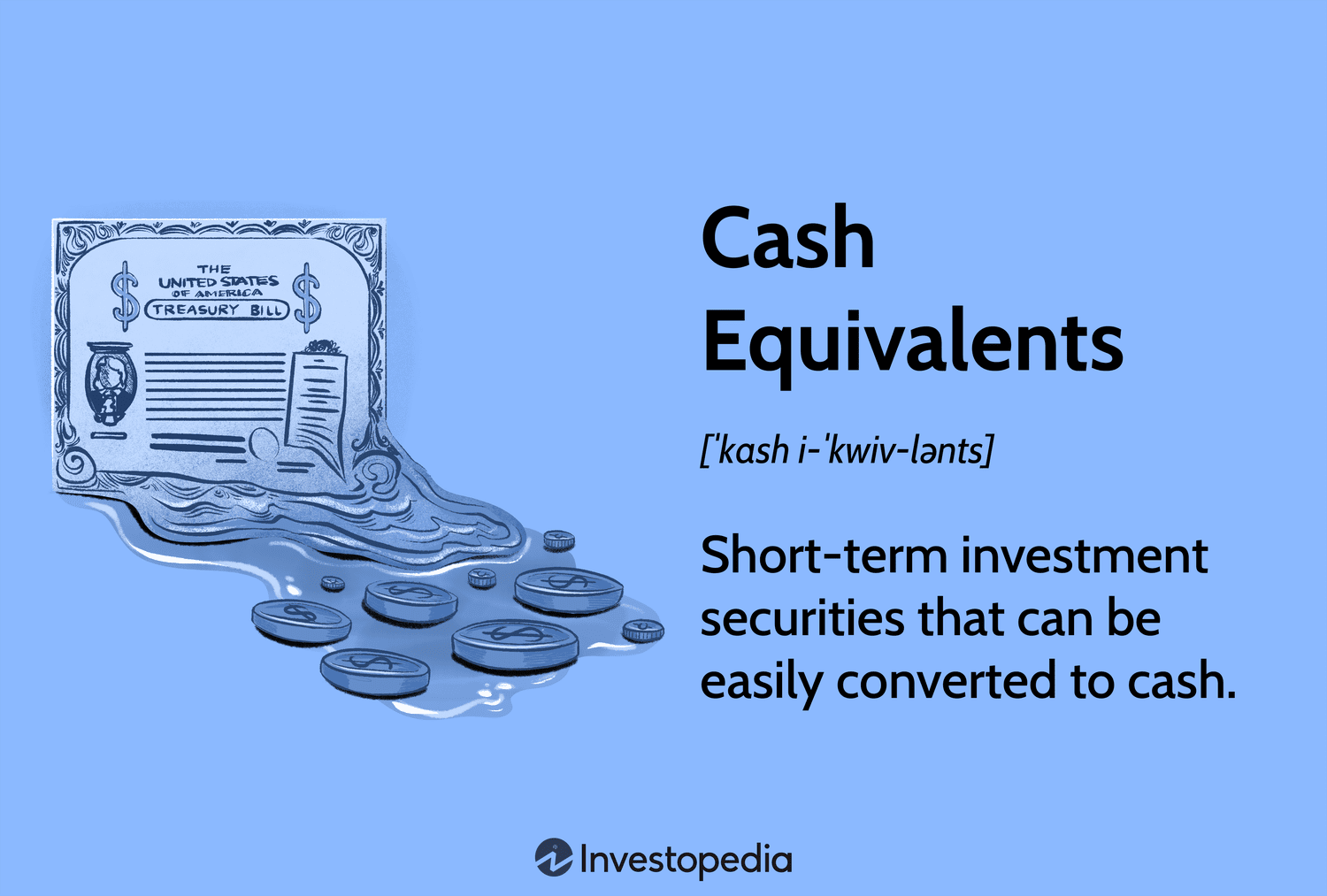
Cash equivalents are securities with solid credit quality and high liquidity. True to their name, they are considered equivalent to cash because they can be quickly converted into actual cash.
Cash and Cash Equivalents is a line item found on balance sheets in the Current Assets section. Cash equivalents are one of three main asset classes in investing. The other two are stocks and bonds.
Cash equivalent securities have a low-risk, low-return profile.
Key Takeaways
- The total for cash and cash equivalents is always placed at the top line of a company’s Current Assets because they are the most liquid assets.
- Stocks, bonds, and cash equivalents make up the three main asset classes in finance.
- These low-risk securities include U.S. government T-bills, bank CDs, bankers’ acceptances, corporate commercial paper, and other money market instruments.
- The amount of cash and cash equivalents on hand speaks to a company’s financial health as it reflects the ability to pay short-term obligations.
Investopedia / Jessica Olah
Understanding Cash Equivalents
Cash equivalents include U.S. government Treasury bills, bank certificates of deposit, bankers’ acceptances, corporate commercial paper, and other money market instruments. These financial instruments often have short maturities, highly liquid markets, and low risk.
Cash equivalents are an important indicator of a company’s financial well-being. Analysts can estimate the advisability of an investment in a particular company by its ability to access cash and convert cash equivalents quickly. This liquidity reflects a company that is able to pay its bills.
Important
When reported on financial statements, investments in these types of liquid accounts are often combined with cash and represent a company’s total holding of money and liquid investments.
Types of Cash Equivalents
Treasury Bills
Treasury bills are commonly referred to as “T-bills.” These are securities issued by the United States Department of the Treasury that mature in one year or less. Companies, financial institutions, and individuals who purchase T-bills lend the government money, which it repays upon maturity. T-bills are sold at a discount and redeemed at face value. The minimum purchase amount is $100 while the maximum is $10 million (for a non-competitive bid) or 35% of the offering amount (for a competitive bid). The yield of T-bills is the difference between the purchase price and the value at redemption.
Commercial Paper
Commercial paper is short-term (less than a year), unsecured debt used by big companies to raise funds to meet short-term liabilities such as payroll. Corporations issue commercial paper at a discount from face value and promise to pay the full face value on the maturity date designated on the note. Maturities range from one to 270 days.
Marketable Securities
Marketable securities are financial assets and instruments that can easily be converted into cash and are therefore very liquid. They are traded on public exchanges and there is usually a strong secondary market for them. Marketable securities can have maturities of one year or less and the rates at which these may be traded has a minimal effect on prices. Examples of marketable securities include T-Bills, CDs, bankers’ acceptances, commercial paper, stocks, bonds, and exchange-traded funds (ETFs).
Money Market Funds
Money market funds are mutual funds that invest only in cash and cash equivalents. They are very liquid investments with excellent credit quality. Money market funds are an efficient and effective tool that companies and organizations use to manage their money since they tend to be more stable compared to other types of funds (such as mutual funds). A money market fund’s share price is always $1 per share. Money market funds invest in cash equivalents.
Short-Term Government Bonds
Short-term government bonds are considered by some to be cash equivalents because they are very liquid, actively traded securities. They are issued by a government to fund government projects. Investors should be sure to consider political risks, interest rate risks, and inflation when investing in government bonds.
Certificate of Deposit (CD)
A certificate of deposit is a type of savings account with a financial institution. It represents a certain amount of a saver’s capital that can’t be accessed by the saver for a specific period of time. In return for the use of their capital, the financial institution pays savers a fixed rate of interest. Savers can choose from CD terms ranging from one-month to five-years. A CD is considered a very safe investment and is insured up to $250,000 when purchased at a federally-insured bank. Should the saver need their money, they may be able to break the CD contract by paying a fee or interest penalty.
Banker’s Acceptance
A banker’s acceptance is a form of payment that is guaranteed by a bank rather than an individual account holder. Because the bank guarantees payments, this short-term issuance is considered to be cash. Bankers’ acceptances are frequently used to facilitate transactions where there is little risk for either party.
What’s Not a Cash Equivalent
Some current assets, although short-term, aren’t considered to be cash equivalents if they’re prohibited from being converted to cash or if they can’t readily be turned into cash. Such assets include:
- Credit collateral
- Inventory
- CDs with contracts that can’t be broken
- Prepaid assets
- Accounts receivable
Features of Cash Equivalents
Different types of cash equivalents usually have the same characteristics. Those characteristics include:
- Liquidity: Cash equivalents must trade in liquid markets. That’s because these investments must be very easy to convert to cash. If an investment is not liquid, it cannot be considered a cash equivalent. For example, a CD that doesn’t allow for early redemption before the maturity date is not a cash equivalent. However, many CDs allow for early redemption with the payment of a fee or relinquishment of a certain amount of interest.
- Short-Term Investment: Cash equivalents must be able to be converted to cash quickly. Therefore, the term of the investment is often very short. Cash equivalents are often considered the most liquid current assets, second only to cash.
- Low-Risk/Volatility: Cash equivalents are meant to be an efficient investment for cash on hand that doesn’t carry a lot of risk. Although there are several concerns regarding default risk and FDIC insurance, cash equivalents are normally low-risk, low-volatility investments.
- Unrestricted Access: Conversion of cash equivalents to cash should be unrestricted. An investor should be able to convert their cash equivalent to cash on demand. The entire purpose of cash equivalents is to provide the same liquid benefits as cash. Investments with inflexible holding terms or a lack of liquidity are not cash equivalents.
Uses of Cash Equivalents
There are several important reasons why a company should store some of its capital in cash equivalents.
To Meet Short-Term Obligations
Cash equivalents are part of a company’s net working capital (current assets minus current liabilities), which it uses to pay invoices for operating expenses, buy inventory, service debts, and make other purchases.
To Build an Emergency Fund
Like people, companies should maintain enough easily accessible cash to handle unexpected costs that might arise, for instance, when business is slow or the economy stumbles. Investing in cash equivalents gives companies the security of cash when they need it and earns them a return. The interest earned is usually higher than that earned from a basic bank account and provides some protection against inflation.
To Be Ready for Future Projects
Companies may intentionally carry higher balances of cash equivalents so they can capitalize on business opportunities when they arise. Instead of locking capital into a long-term, illiquid, and maybe volatile investment, a company can choose to invest added cash in cash equivalents in the event it needs funds quickly.
As Required by Debt Agreements
Some lenders may require that, in return for a loan, a company maintain a designated amount of liquid cash equivalents. This financial restriction is intended to protect the lender’s financial interest should business slow. It can also result in better loan terms (due to less risk) for the company that agrees to it. Moreover, a company can benefit from the discipline of saving via cash equivalents.
Advantages and Disadvantages of Cash Equivalents
While investing in cash equivalents has its benefits, they also come with several downsides.
Advantages
- Cash equivalents can be a more efficient use of capital compared to keeping cash in a basic bank account. They often pay more interest even as they offer the same easy, convenient accessibility.
- These current assets are as reliable as cash and can be accessed quickly. As opposed to other types of financial or investment vehicles with long maturities or holding requirements, cash equivalents are not meant to be invested for long.
- Many cash equivalent products have fixed rates of interest. For example, a certificate of deposit guarantees an investor a certain rate for a specific period of time, yielding a fixed income. This interest rate and income security may be desirable for certain savers. Fees or fines may apply for early redemptions.
Disadvantages
- Although cash equivalents can earn higher interest rates than cash in a bank account, they usually earn much less compared to other, longer term, less liquid investments. For capital growth and to increase the value of a business, an appropriate amount of money should be invested in the company or higher yielding (and higher risk) investments.
- Cash equivalents are subject to risk, even if that risk is low. A cash equivalent is backed by its issuer, whether that’s a government or corporation. Should that entity default, the investor may not receive the agreed-upon return. FDIC insurance, for depositors at federally-insured financial institutions, covers principal and accrued interest (through the date of failure) up to $250,000 per account, per account ownership type.
- Fees or fines may apply for early redemptions of certain cash equivalents, such as CDs.
Cash Equivalent Quick Reference Comparison
Pros
-
Earns higher rate compared to cash in many savings accounts
-
Is highly liquid
-
May offer fixed rates of interest
-
Are generally considered to be safe investments
Cons
-
Often earns a much lower rate of interest than longer-term, less liquid investments
-
Still subject to risk of default by the issuing entity
-
May not be covered by federal insurance
Example of Cash Equivalents
In 2021, Microsoft invested in, held, and conducted transactions with cash equivalents throughout the year.
- On March 9, 2021, Microsoft acquired ZeniMax Media Inc. for a purchase price of $8.1 billion. The purchase price included $768 million of cash and cash equivalents.
- Microsoft held $130.3 billion in cash, cash equivalents, and other short-term investments at its fiscal year-end. Of that total, $14.22 billion was in cash and cash equivalents, an increase from $13.576 billion in 2020.
- The company stated that it believed cash, cash equivalents, and short-term investments would be enough to continue to fund operating activities.
How Are Cash Equivalents Used?
If a company has excess cash on hand, it might invest it in a cash equivalent called a money market fund. This fund is a collection of short-term investments (i.e., generally, with maturities of six months or less) that earns a higher yield than money in a bank account. When the company decides it needs cash, it sells a portion of its money market fund holdings and transfers the proceeds to its operating account.
Why Are Cash Equivalents Important?
Cash equivalents strike a balance between investing, risk, and liquidity. They give a company easy access to cash should it need it quickly. In addition, cash equivalents allow companies to earn some amount of interest as they plan how to utilize their funds in the long term.
What Is the Difference Between Cash and Cash Equivalents?
Cash is ownership of actual U.S. dollars or other currencies. Cash equivalents are interest-earning financial vehicles/investments that are widely traded, highly liquid, and easy to convert to cash. Cash equivalents are not identical to cash in hand, though they have such low risk and high liquidity that they’re often considered just as accessible.
The Bottom Line
If a company wants to earn some return on its money as it plans its long-term strategy, it can choose to invest some of its capital in cash equivalents. These very short-term, low risk, highly liquid investments may not make a tremendous amount of money. However, they earn more than cash in a bank account and can be converted into cash quickly and easily.
[ad_2]
Source link