[ad_1]
What Is a Blue Chip Stock?
Blue chip stocks are issued by large, financially sound companies with a long history of consistent performance and strong reputations. These companies usually boast large market capitalizations and are typically leaders in their respective sectors. Recognizable household names like IBM Corp., Coca-Cola Co., Microsoft, American Express, McDonald’s, and Boeing Co. are prime examples of blue chip stocks.
These stocks are popular among investors due to their reliable earnings and frequent dividend payments. They provide an appealing combination of growth and stability, often serving as anchors in diversified investment portfolios. Understanding what makes a stock a blue chip can guide investors in making informed decisions aligned with their financial goals.
Key Takeaways
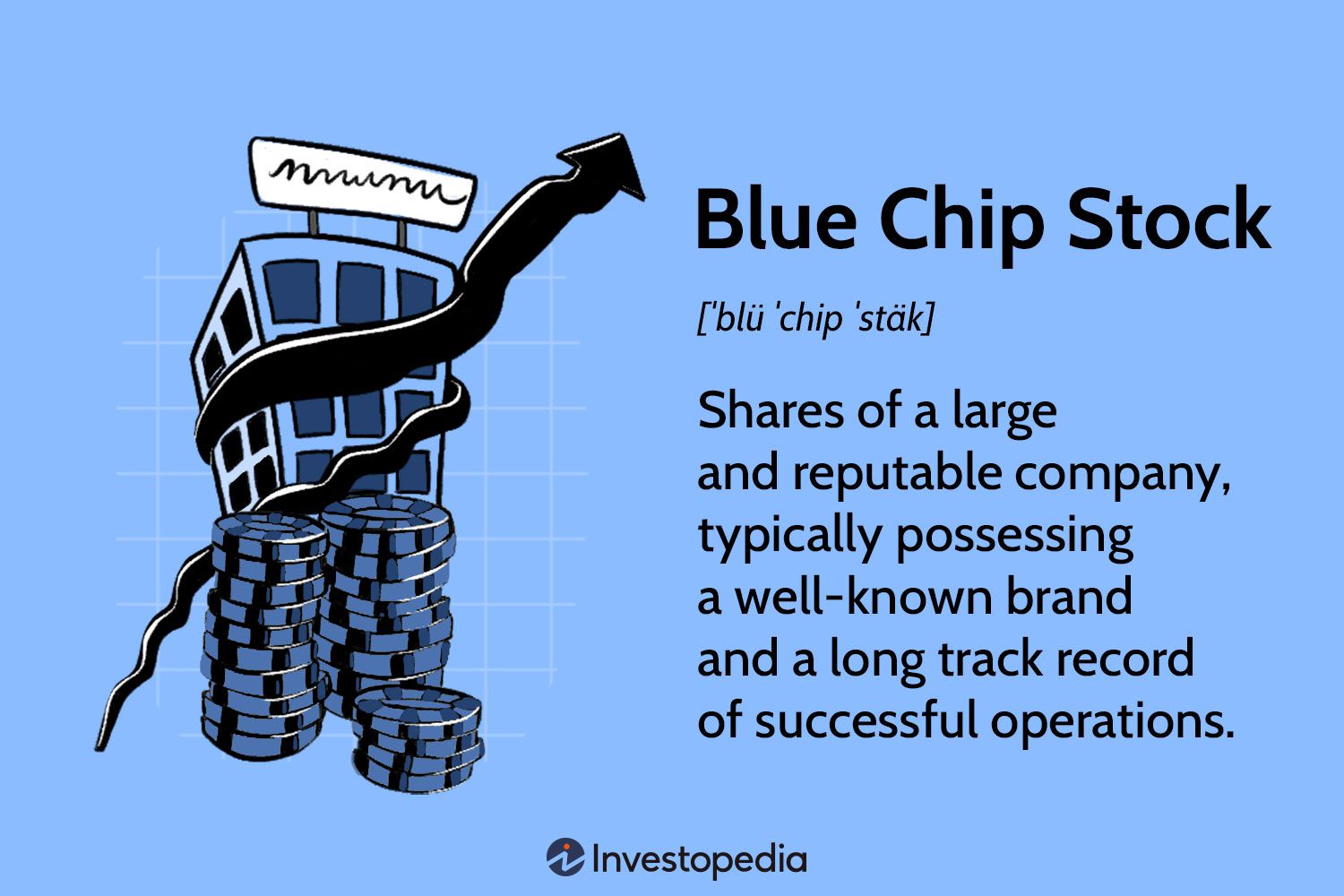
- Blue chip stocks are shares from large, well-established, financially sound companies with a proven track record of reliability and often pay dividends to investors.
- These stocks are usually part of major market indexes like the Dow Jones Industrial Average and the S&P 500, signaling their stability and reputational strength.
- While blue chip stocks are generally considered safe investments due to their longstanding stability, they are not immune to economic downturns, as seen in the 2008 financial crisis.
- Investors can purchase blue chip stocks individually or via mutual funds and ETFs, making them a versatile option for both growth and income-focused portfolios.
- A diversified portfolio should not solely rely on blue chip stocks; investors are advised to include a mix of mid-cap, small-cap stocks, and other asset classes to balance risk.
Characteristics of Blue Chip Stocks
While dividend payments are not absolutely necessary for a stock to be considered a blue chip, most blue chips have long records of paying stable or growing dividends.
A blue chip stock is generally a component of the most reputable market indexes or averages, such as the Dow Jones Industrial Average, the Standard & Poor’s (S&P) 500, and the Nasdaq-100 in the United States, the TSX-60 in Canada, or the FTSE Index in the United Kingdom.
How big a company needs to be to qualify for blue chip status is open to debate. A generally accepted benchmark is a market capitalization of $10 billion, although market or sector leaders can be companies of all sizes.
For example, the T. Rowe Price Blue Chip Growth Fund doesn’t have a specific guideline for what type of company qualifies outside of its focus on large-cap and mid-cap companies that are well-established in their industries. Its top ten holdings have market capitalizations that range from over $670 billion (Tesla) to over $2.4 trillion (Microsoft).
Fast Fact
The term “blue chip” comes from poker, where blue chips are the most valuable.
Why Blue Chip Stocks Are Considered Safe Investments
Blue chips are seen as safe because of their financial stability but can still struggle, as shown by GM and Lehman Brothers during the 2008 recession.
Evaluating the Investment Potential of Blue Chips
Whether or not blue chip stocks (or any other securities) represent a good investment depends on an investor’s financial needs, investment objectives, diversification goals, risk tolerance, and investment style.
Blue chips are important in a portfolio, offering a mix of growth and stability to offset market ups and downs.
These companies are consistent top performers, and their dividends are usually reliable.
Fast Fact
The Coca-Cola Company has paid dividends to investors for over 120 years, since 1893.
Incorporating Blue Chips into a Diversified Portfolio
Blue chips are good as core portfolio holdings but shouldn’t be the whole portfolio. Consider diversifying with bonds, cash, mid-caps, and small-caps.
Younger investors can take more risk with stocks like blue chips, while older investors might prefer safer options like bonds and cash.
What Makes a Company a Blue Chip?
Blue chip stocks are the titans of their sectors—industry-defining companies that are well-known, well-capitalized, long-term stable plays with solid financial prospects. Many blue chip stocks appear on the Dow Jones Industrial Average and the S&P 500. They also appear on the non-benchmark compiled list known as the Nifty Fifty.
What Companies Are Considered to Be Blue Chips?
Many of the largest companies in the S&P 500 or the Dow 30 are blue chips, such as IBM, JPMorgan Chase, Walmart, Microsoft, and American Express.
Where Does the Term “Blue Chip” Come From?
The term “blue chip stock” comes from the world of poker, where chips used in gambling have different colors to represent different dollar amounts. A blue chip is typically the one with the highest value of all, surpassing white chips and red chips.
How Do I Invest in Blue Chip Stocks?
An investor can buy blue chip stocks individually, or by buying mutual funds or exchange-traded funds (ETFs) that invest in them. In some cases, funds and ETFs will hold a variety of stocks and asset classes, including blue chips. In other cases, the funds or ETFs might be focused exclusively on blue chips, such as an ETF that tracks the Dow Jones Industrial Average (which comprises 30 of the largest blue chip stocks).
The Bottom Line
Blue chip stocks are aptly named because they’re issued by the best companies in an industry/sector and usually have rock-solid financials and enviable valuations.
Blue chips often show a history of strong performance and attractive returns, making them a solid portfolio addition based on your goals.
Yet, they’re not immune to market downturns and economic upheaval. That’s something all investors considering blue chips should bear in mind.
[ad_2]