

[ad_1]
What Is a Contract for Difference (CFD)?
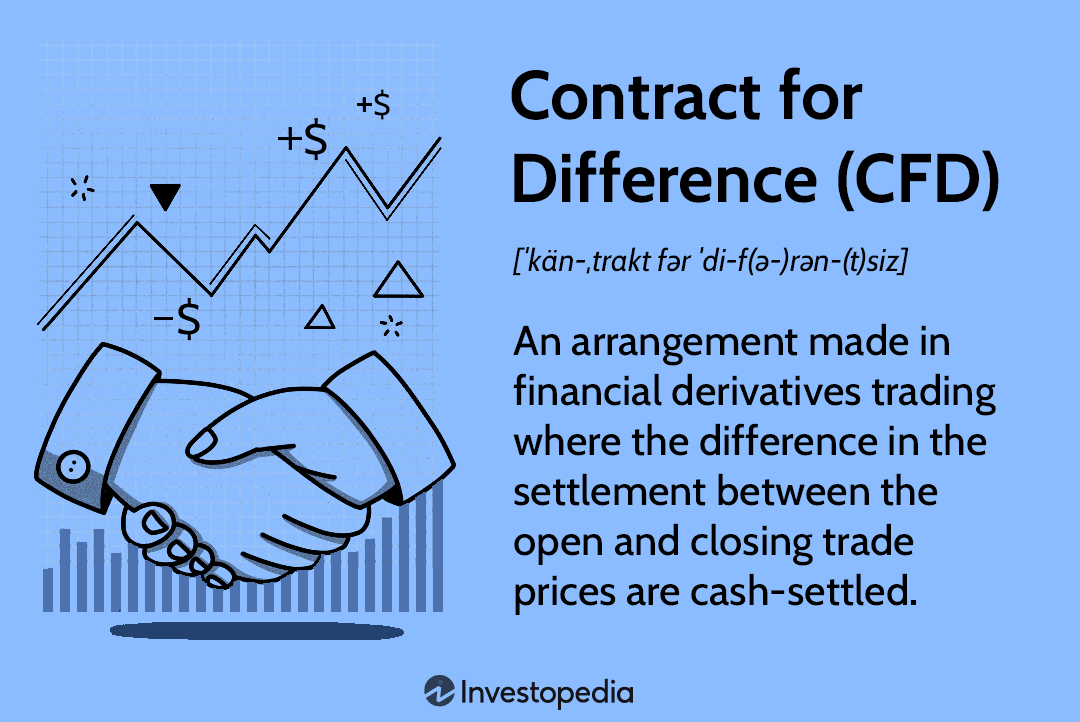
A Contract for Difference (CFD) represents a sophisticated financial derivative used by traders to speculate on short-term price movements of various underlying instruments. Settlements are executed in cash as there is no exchange of physical goods or securities.
CFDs offer experienced investors the ability to bet on the price direction of assets, predicting either a rise or fall to profit from market volatility. However, due to their complex nature and regulatory restrictions, CFDs are not available for trading in the United States.
Key Takeaways
- A Contract for Difference (CFD) is a financial derivative that lets traders speculate on short-term price movements without owning the underlying asset.
- CFDs offer high leverage, which can amplify both potential gains and losses, with traders often required to maintain specific account balances.
- While CFDs allow traders to participate in global financial markets with minimal initial capital requirements, they are not permitted in the U.S. due to regulatory concerns.
- CFDs can be used to trade a variety of assets, including stock indices, ETFs, and commodity futures, through a network of brokers.
- The CFD market’s lack of regulation means investors rely heavily on the credibility and reputation of their brokers.
Investopedia / Julie Bang
Understanding Contracts for Difference (CFD)
CFDs allow traders to trade in the price movement of securities and derivatives, the financial investments that are derived from an underlying asset.
CFDs are essentially used by investors to make price bets as to whether the price of the underlying asset or security will rise or fall.
Fast Fact
CFD traders can bet on the price moving up or down. Traders who expect an upward movement in price will buy the CFD. Those who see the opposite downward movement will sell an opening position.
The buyer will offer their holding for sale should the buyer of a CFD see the asset’s price rise. The difference between the purchase price and the sale price are netted together. The net difference representing the gain or loss from the trades is settled through the investor’s brokerage account.
An opening sell position can be placed if a trader believes that a security’s price will decline. They must purchase an offsetting trade to close the position. Again, the net difference of the gain or loss is cash-settled through their account.
Trading CFDs: Assets and Opportunities
Contracts for difference can be used to trade many assets and securities, including exchange-traded funds (ETFs). Traders will also use these products to speculate on the price moves in commodity futures contracts such as those for crude oil and corn. Futures contracts are standardized agreements or contracts with obligations to buy or sell a particular asset at a preset price with a future expiration date.
Fast Fact
CFDs allow investors to trade the price movements of futures but they’re not futures contracts by themselves. CFDs don’t have expiration dates containing preset prices. They trade like other securities with buy-and-sell prices.
CFDs trade over-the-counter (OTC) through a network of brokers that organize the market demand and supply for CFDs and make prices accordingly. They’re not traded on major exchanges such as the New York Stock Exchange (NYSE). The CFD is a tradable contract between a client and their broker. They’re exchanging the difference in the initial price of the trade and its value when the trade is unwound or reversed.
Weighing the Pros and Cons of CFDs
Advantages
-
CFDs let investors trade on price changes in assets like ETFs, stock indices, and commodity futures.
-
CFDs offer the benefits and risks of owning a security without actual ownership.
-
CFDs use leverage, allowing investors to put up a small percentage of the trade amount with a broker.
-
CFDs allow investors to easily take a long or short position or a buy and sell position.
Disadvantages
-
Leverage can amplify gains with CFDs but leverage can also magnify losses.
-
High price volatility can cause large gaps between the bid (buy) and ask (sell) prices from brokers.
-
The CFD industry lacks strict regulation and is banned in the U.S., so traders depend on their broker’s credibility.
-
Investors with losing positions may receive a margin call from their broker to deposit more funds.
Benefits of Trading CFDs
CFDs offer the benefits and risks of owning a security without actual ownership or physical delivery.
CFDs are traded on margin. The broker allows investors to borrow money to increase leverage or the size of the position. Brokers require traders to maintain certain account balances to permit this type of transaction.
Trading on margin CFDs typically provides higher leverage than traditional trading. Standard leverage in the CFD market can be as low as a 10% margin requirement and as high as a 50% margin but it can vary significantly by broker. Lower margin requirements result in smaller capital outlays and potentially higher returns.
Important
Fewer rules and regulations surround the CFD market as compared to standard exchanges. As a result, CFDs can have lower capital requirements or cash required in a brokerage account as a result.
Traders can often open an account with a broker for as little as $1,000. A CFD owner can also receive cash dividends, increasing the trader’s return on investment, because CFDs mirror corporate actions taking place. Most CFD brokers offer products in all major markets worldwide. Traders can easily access any open market through the broker’s platform.
CFDs allow investors to easily take a long or short position or a buy and sell position. The CFD market typically doesn’t have short-selling rules. An instrument may be shorted at any time. There’s no borrowing or shorting cost because there’s no ownership of the underlying asset.
Few or no fees are charged for trading a CFD. Brokers make money from the trader paying the spread. The trader pays the ask price when buying and takes the bid price when selling or shorting. The brokers take a piece or spread on each bid and ask price that they quote.
Risks and Challenges of Using CFDs
Bid-ask spreads can be wide if the asset shows extreme volatility. Large spreads on entries and exits can prevent profits from small CFD movements, reducing winning trades and increasing losses.
The CFD industry isn’t highly regulated so the broker’s credibility is based on its reputation and financial viability. CFDs are not available in the United States as a result.
CFDs use leverage, meaning investors with losing positions might face broker margin calls. This requires that additional funds be deposited to balance out the losing position. Leverage can amplify gains with CFDs but leverage can also magnify losses. Traders are at risk of losing 100% of their investment. Traders borrowing from brokers incur a daily interest charge.
Example of a CFD
An investor wants to buy a CFD on the SPDR S&P 500 (SPY), an exchange-traded fund that tracks the S&P 500 Index. The broker requires 5% down for the trade.
The investor buys 100 shares of the SPY for $250 per share for a $25,000 position from which only 5% or $1,250 is paid initially to the broker.
Two months later the SPY is trading at $300 per share and the trader exits the position with a profit of $50 per share or $5,000 in total.
The CFD is cash-settled, with an initial position of $25,000 and a closing position of $30,000 ($300 * 100 shares) netted out, crediting a $5,000 gain to the investor’s account.
What Is One Difference Between a Contract for Differences (CF) and a Futures Contract?
Futures contracts have an expiration date at which time there’s an obligation to buy or sell the asset at a preset price. CFDs are different in that there is no expiration date and you never own the underlying asset.
Can U.S. Citizens Buy CFDs?
CFDs are not allowed by the U.S. Securities and Exchange Commission. These over-the-counter (OTC) products are unregulated and pose a large risk of losses.
In What Countries Are CFDs Legal?
CFDs are allowed in several countries with listed OTC markets. They include Belgium, Canada, Denmark, France, Germany, Italy, the Netherlands, New Zealand, Norway, Singapore, South Africa, Spain, Sweden, Switzerland, Thailand, and the United Kingdom.
The Bottom Line
Investing in CFDs allows you to trade the price movements of stock indices, ETFs, and commodity futures. You get all the benefits and risks of owning a security without actually owning it. Using leverage allows investors to put up only a small percentage of the trade amount with a broker.
The drawback is that such leverage can lead to significant losses due to extreme price volatility. And the limited regulation of the CFD market means U.S. residents cannot trade them.
Disclosure: This article is not intended to provide investment advice. Investing in securities entails varying degrees of risk and can result in partial or total loss of principal. The trading strategies discussed in this article are complex and should not be undertaken by novice investors. Readers seeking to engage in such trading strategies should seek out extensive education on the topic.
[ad_2]
Source link


