[ad_1]
What Is a Balloon Loan?
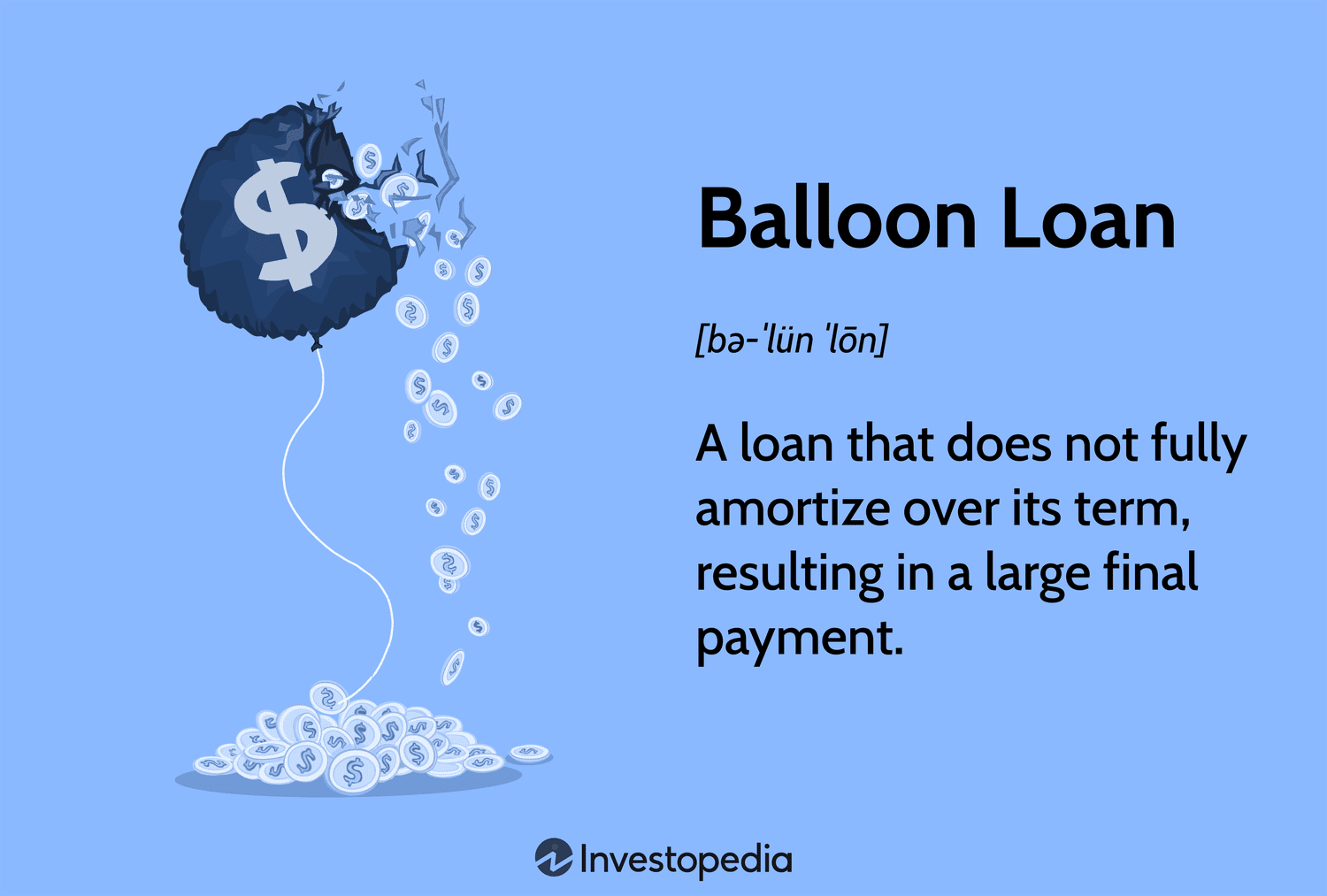
A balloon loan is a type of loan that does not fully amortize over its term. Since it is not fully amortized, a balloon payment is required at the end of the term to repay the remaining balance of the loan.
Balloon loans can be attractive to short-term borrowers because they typically carry lower interest rates than loans with longer terms. However, the borrower must be aware of refinancing risks as there’s a possibility the loan may reset at a higher interest rate.
Key Takeaways
- Balloon loans require a large final payment after low monthly payments, making them risky without a solid repayment plan.
- These loans are attractive for short-term borrowing due to lower interest rates but carry refinancing risks if interest rates rise.
- Balloon loans are commonly used in industries like construction and real estate flipping because of their initial affordability.
- Borrowers should have a strategy to handle the balloon payment, such as selling the asset or refinancing, to avoid default.
Understanding the Mechanics of Balloon Loans
Mortgages, especially balloon mortgages, often involve balloon payments and usually last five to seven years. However, the monthly payments through this short term are not set up to cover the entire loan repayment. Instead, the monthly payments are calculated as if the loan is a traditional 30-year mortgage.
The payment structure of a balloon loan differs greatly from a traditional loan. By the end of this term, the borrower has paid only a part of the principal, with the rest due at once. At that point, the borrower may sell the home to cover the balloon payment or take out a new loan to cover the payment, effectively refinancing the mortgage. Alternatively, they may make the payment in cash.
Important
Defaulting on a balloon loan will negatively impact the borrower’s credit rating.
Balloon Loan Scenario: An Illustrative Example
Let’s say a person takes out a $200,000 mortgage with a seven-year term and a 4.5% interest rate. Their monthly payment for seven years is $1,013. At the end of the seven-year term, they owe a $175,066 balloon payment.
Special Considerations for a Balloon Loan
Some five-year balloon loans have a reset option that lets the interest rate and amortization schedule adjust according to current rates. If a balloon loan does not have a reset option, the lender expects the borrower to pay the balloon payment or refinance the loan before the end of the original term.
When interest rates are high and the borrower plans to sell soon, a balloon loan may be sensible. However, it carries high risk at the end of the term. The borrower must save for the balloon payment. What’s more, if interest rates are low or are expected to rise, they may well be higher when the borrower needs to refinance.
Weighing the Advantages and Disadvantages of Balloon Loans
Balloon loans offer clear advantages for some buyers.
- Monthly payments are lower than traditional loans since little principal is repaid, allowing larger loans.
- High interest rates have less impact as payments are reduced due to limited principal repayment.
- Not committing to decades of paying at a high interest rate; the terms are typically five to seven years, after which the borrower gets to refinance, possibly at a lower interest rate.
However, the large balloon payment at the end is a significant disadvantage.
- Borrowers may default if they can’t arrange financing for the balloon payment or fund it themselves.
- Being unable to sell the property at a high enough price to pay the balloon payment, and then defaulting on the loan.
- Being able to successfully refinance the balloon loan but at a higher interest rate, driving up monthly payments (this will be even more true if the new loan is amortized and includes paying off the principal).
There’s also an underlying risk of opting for a balloon loan. It’s easy to be tricked by the small size of the original interest-only (or mostly) monthly payment into borrowing more money than an individual can comfortably afford to borrow. That is also a potential road to financial ruin.
What Industries Use Balloon Loans?
Balloon loans are popular in the construction industry and for home flippers. Contractors or real estate investors use the low initial payments to complete work on a project, hoping to sell it before the balloon payment comes due.
What Happens if You Can’t Pay Your Balloon Payment?
Defaulting on your balloon payment is the same as defaulting on any loan—it can lead to foreclosure and repossession of property. Defaulting will ruin your credit rating, making it harder to borrow in the future.
Can You Refinance a Balloon Loan?
Yes. Many people plan to refinance a balloon loan before the balloon payment is due to take advantage of the more affordable initial interest-only period, hoping that interest rates will be more favorable later. This is risky, however—interest rates are volatile, and you may end up refinancing for a higher rate than if you had chosen a fixed-interest rate loan in the first place.
The Bottom Line
Balloon loans present an opportunity for lower initial payments, making them appealing to short-term borrowers or those in industries like construction and home flipping. However, they carry significant risk due to the large balloon payment at the end of the term. Borrowers must ensure they have a clear plan to cover this payment, either through refinancing or other means. Understanding the potential for refinancing risk and preparing for the possibility of higher interest rates are crucial. Balloon loans can offer savings, but borrowers must realistically assess their ability to manage the final balloon payment to avoid financial distress.
[ad_2]